Gift Sets
 Fragrances
 Whip Lush
 BYOB Sale

 Eye Like Options
 Glow Getter
 Dart Its
 Stacked In Your Favour
 Bundles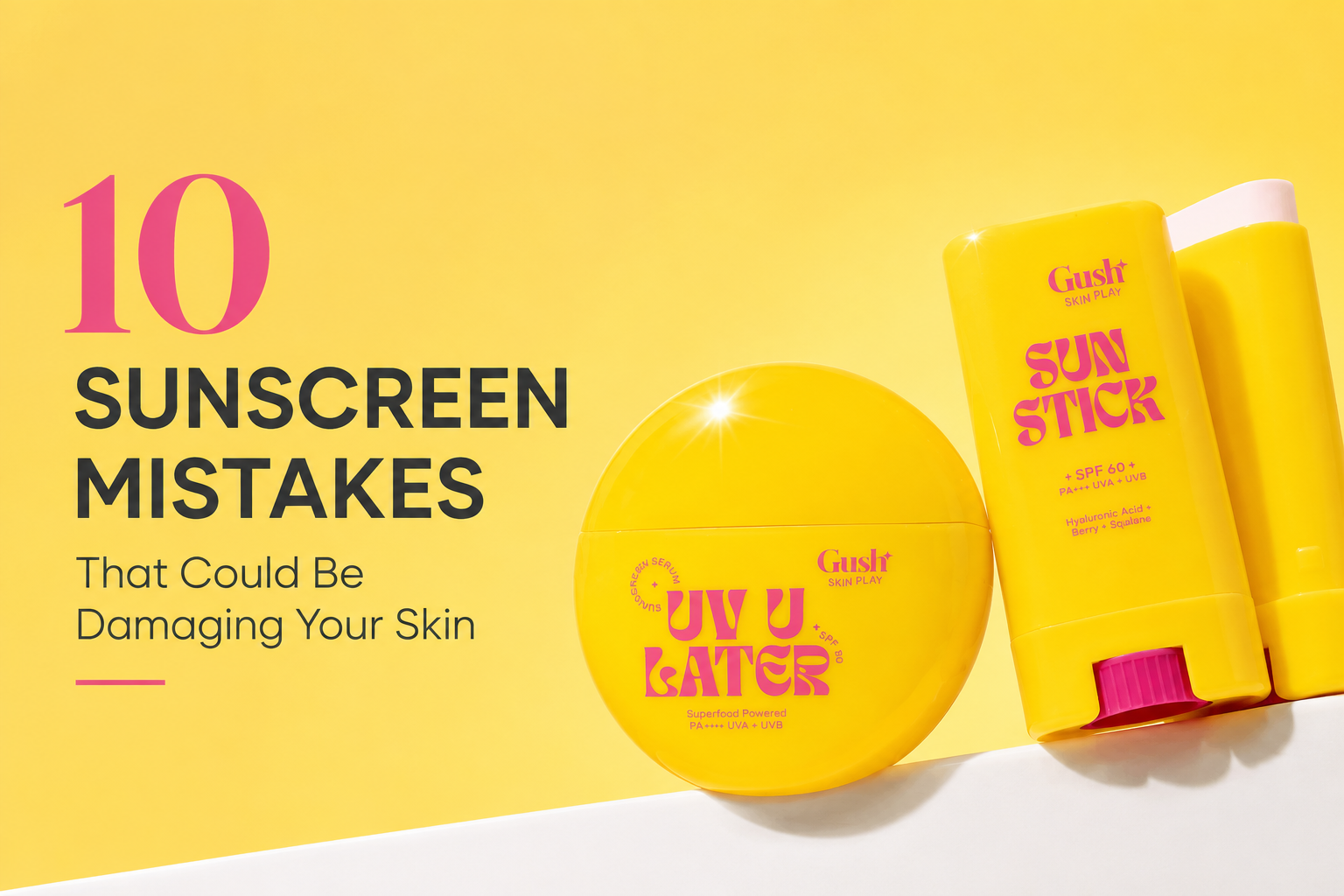
10 Sunscreen Mistakes That Could Be Damaging Your Skin
Most people who use sunscreen are not getting the protection they think they are.
Not because the product does not work. Because of how they are using it.
Sunscreen is one of those products where small errors compound over time. You think you are protected. You are not. And the damage from that gap builds up quietly over years before it becomes visible as pigmentation, premature ageing, and uneven skin tone.
This guide covers the ten most common sunscreen mistakes, why each one matters, and how to fix it. With recommendations from Gush Beauty where they fit naturally.
Mistake One: Not Applying Enough
This is the most common sunscreen mistake and the one with the most impact.
Most people apply about 25 to 50 percent of the amount needed for the SPF on the label to be accurate. The recommended amount for the face and neck together is about a quarter teaspoon or 1.5ml. That is more product than most people use in a single application.
A simple way to check: use the two finger rule. Squeeze sunscreen along the length of your index and middle fingers. That is roughly the right amount for your face and neck.
The UV U Later SPF 50 Sunscreen Serum has a serum texture that makes applying a full, even layer much easier than thick cream formulas. It spreads evenly across the skin without feeling heavy, which means you are more likely to apply enough of it consistently.
How do I know if I am applying enough sunscreen?
Your face should have a visible, even layer of product on it after application, not just a light smear. If your sunscreen disappears into your skin immediately without any moment of visible coverage, you are likely not applying enough. Apply, let it absorb for sixty seconds, and check. With the right amount, there should be a brief moment where the product is visible before it absorbs.
Mistake Two: Skipping It on Cloudy or Rainy Days
Cloud cover blocks visible sunlight. It does not block UV radiation.
UVA rays, the ones that cause pigmentation, collagen breakdown, and premature ageing, penetrate cloud cover with minimal reduction. On a fully overcast day, up to 80 percent of UV radiation still reaches the skin. Skipping sunscreen because it looks grey outside leaves your skin exposed to the majority of the damage that sunscreen is designed to prevent.
The habit that solves this is making sunscreen a fixed part of your morning routine rather than a weather-dependent decision. Apply the UV U Later SPF 50 Sunscreen Serum every morning regardless of what the sky looks like. Remove the weather assessment from the decision entirely.
Mistake Three: Relying on SPF in Foundation or Moisturiser Alone
SPF in foundation and moisturiser is a bonus, not a substitute.
To get the full SPF listed on a foundation or tinted moisturiser, you would need to apply far more product than anyone actually wears as a makeup base. The amount of tinted moisturiser most people apply delivers a fraction of the listed SPF. A thin layer of SPF 30 foundation applied as most people apply foundation delivers something closer to SPF 5 to 10 in practice.
A dedicated sunscreen applied underneath your base, before any makeup, gives you reliable protection regardless of how much or little foundation goes on top. The UV U Later SPF 50 Sunscreen Serum absorbs within about a minute and sits comfortably under all makeup formats without pilling or shifting your base during the day.
Can I ever skip dedicated sunscreen if my moisturiser has SPF?
The same principle applies. The SPF in a moisturiser is accurate only when applied in the recommended quantity for a sunscreen, which is more than most people apply as a daily moisturiser. Using a moisturiser with SPF as your primary sun protection means your effective protection is lower than the label suggests. For most people in Indian UV conditions, a dedicated SPF product is worth the extra step.
Mistake Four: Not Reapplying
Sunscreen breaks down over time. UV exposure itself degrades the active filters. Sweat, sebum, touching your face, and time passing all reduce how well it works.
The recommended reapplication interval is every two hours when outdoors. After swimming or heavy sweating, reapplication should happen immediately regardless of timing.
Most people apply sunscreen once in the morning and consider themselves protected for the rest of the day. For a predominantly indoor day with minimal direct sun exposure, one morning application is generally sufficient. But for outdoor time, outdoor commuting, or sports and exercise, the protection from that morning application has degraded significantly by midday.
The Sunscreen Stick from Gush Beauty is designed for exactly this. It applies cleanly over makeup, does not require tools or washing hands, and takes ten seconds to use. Keep it in your bag and treat midday reapplication as a normal part of your routine rather than an exceptional one.
Mistake Five: Stopping Application at the Jawline
Most people apply sunscreen to the centre of the face and stop at the jawline. The neck, ears, chest, and backs of hands receive daily UV exposure without any protection.
These areas show visible UV-related ageing and pigmentation over time, often more dramatically than the face because they are consistently overlooked. The skin on the neck and chest is thinner and more vulnerable than facial skin.
Extend your sunscreen application past the jaw every morning. Include the neck, the tops of the ears, and the backs of your hands. These areas are exposed to the same UV radiation as your face and deserve the same protection.
Mistake Six: Using Expired Sunscreen
Sunscreen active filters degrade over time. An expired sunscreen may look, smell, and feel the same as a fresh one, but the filters responsible for UV protection have lost a significant portion of their efficacy.
Most sunscreens have a PAO symbol on the packaging, a small open jar icon with a number indicating how many months after opening the product is usable. They also have an expiry date on the base or back of the packaging.
If you are unsure how old your sunscreen is, replace it. The cost of a new sunscreen is significantly less than the cost of treating the skin damage that accumulates from using a product that is no longer working.
Mistake Seven: Applying It Too Late Before Going Outside
Some chemical sunscreen filters need a short period on the skin before they are fully activated. The commonly cited recommendation is to apply fifteen to thirty minutes before sun exposure for chemical formulas.
In practice, the difference within that window is smaller than often stated, but applying sunscreen immediately before walking out the door and then spending significant time in direct sun gives less initial protection than applying it as part of your indoor morning routine.
Build sunscreen application into your routine before you leave the house rather than at the door on your way out. The UV U Later SPF 50 Sunscreen Serum absorbs quickly and is best applied at the end of your skincare routine, several minutes before you head out, rather than as a last step on the way to the door.
Does sunscreen need time to activate before it works?
Chemical sunscreen filters benefit from a short absorption period before full UV protection is achieved. Mineral filters using zinc oxide or titanium dioxide are considered effective immediately on application. For most daily routines, applying sunscreen as part of your indoor morning skincare sequence gives it adequate time before you encounter meaningful UV exposure during your commute or day.
Mistake Eight: Assuming Indoor Days Need No SPF
UVA rays penetrate glass. If you work near a window, sit in a car during your commute, or spend time in any glass-fronted space, you receive meaningful UVA exposure throughout the day.
UVA radiation is the type primarily responsible for pigmentation, collagen breakdown, and visible skin ageing. It does not cause immediate sunburn the way UVB does, which means its effects are less immediately visible and more commonly overlooked. But the cumulative damage from years of unprotected indoor UVA exposure is significant and real.
Daily sunscreen use on all days, including full indoor days, is the consistent recommendation from dermatologists for this reason.
Mistake Nine: Skipping SPF on the Eyes and Lips
The skin around the eyes is the thinnest and most delicate skin on the face. It is also one of the areas most prone to showing UV-related ageing. Most sunscreens can be safely applied to the orbital bone area around the eye, stopping short of the waterline.
The lips have no melanin and no natural UV protection. UV exposure on the lips contributes to dryness, pigmentation, and long-term lip health concerns. An SPF lip balm or a lip product with UV protection addresses this directly. The Butter Balm Hybrid Gloss Balm provides conditioning to the lips and can be used as a daily lip prep that supports lip health alongside your regular SPF routine.
Mistake Ten: Choosing a Formula That Does Not Suit Your Skin
The most expensive, highest SPF sunscreen in the world offers zero protection if you skip it because you hate how it feels.
A sunscreen that feels greasy on oily skin, cakey under makeup, white cast-heavy on deeper skin tones, or tight and drying on dry skin is a sunscreen that gets skipped on any morning when something else is competing for your attention.
Finding a formula that suits your skin type and fits naturally into your routine is the most important sunscreen decision you can make. For most Indian skin types and climates, a lightweight serum or gel-formula with broad spectrum SPF 50 and no white cast is the ideal daily format.
The UV U Later SPF 50 Sunscreen Serum is formulated to address every common reason Indian skin types skip sunscreen. No white cast on any skin tone. Serum texture that absorbs in about a minute. No greasiness or heaviness under makeup. SPF 50 PA+++ broad spectrum protection. For midday reapplication that does not require tools or product removal, the Sunscreen Stick handles that without any disruption to your base.
Both are from the Skin Play collection.
Frequently Asked Questions
How do I know if my sunscreen is broad spectrum?
Look for the words broad spectrum on the label. This means the product has been tested and verified to protect against both UVA and UVB rays. Without this label, the SPF number only tells you about UVB protection. For Indian skin and conditions, broad spectrum protection covering both types of radiation is the minimum standard worth applying.
Why is my skin still getting darker even though I wear sunscreen?
The most likely reasons are applying too little, not reapplying during outdoor exposure, or the sunscreen not offering adequate UVA protection. Check that your formula is broad spectrum, that you are applying a full recommended amount, and that you are reapplying every two hours in direct sun. Even small gaps in any of these three areas significantly reduce the actual protection you receive.
Can sunscreen completely prevent pigmentation?
Sunscreen significantly reduces UV-triggered pigmentation and prevents existing marks from deepening. It does not fully prevent all pigmentation because some internal factors also contribute. But for post-inflammatory hyperpigmentation, the dark marks left after pimples on Indian skin, consistent daily SPF is one of the most effective and evidence-backed preventive measures available.
Is SPF 50 really better than SPF 30 for everyday use?
The difference in percentage terms is small, about one percent more UVB blocked. But for Indian skin tones that are prone to pigmentation, SPF 50 provides a meaningful additional margin, particularly for outdoor time and high UV index days common across India for most of the year. SPF 50 broad spectrum is the recommended choice for most Indian skin types in most conditions.
Why does my sunscreen pill under my makeup?
Pilling usually happens when sunscreen has not fully absorbed before makeup is applied on top, or when it is applied over products that are not yet fully absorbed themselves. Give your sunscreen sixty seconds to absorb after applying before you start your makeup. The UV U Later SPF 50 Sunscreen Serum is formulated specifically to minimise pilling under makeup.
How do I fix sunscreen white cast on darker skin tones?
Switch to a chemical sunscreen formula. Chemical filters absorb into the skin and leave no visible residue. The white cast associated with sunscreen comes primarily from mineral formulas using zinc oxide or titanium dioxide, which are opaque and sit on top of the skin. The UV U Later SPF 50 Sunscreen Serum uses a chemical filter system and leaves no cast on any Indian skin tone.
Does sweating mean I need to reapply sooner than two hours?
Yes. Heavy sweating removes sunscreen from the skin faster than normal wear. If you have been exercising outdoors, sweating during a commute in humid conditions, or in any situation involving significant perspiration, reapply with the Sunscreen Stick as soon as possible rather than waiting for the two-hour mark.
Final Thoughts
Most sunscreen mistakes are easy to fix once you know what they are.
Apply enough. Apply it every day regardless of weather. Use a dedicated SPF product rather than relying on SPF in makeup. Reapply when you need to. Choose a formula your skin actually likes.
Those five corrections alone significantly improve the protection you receive from the sunscreen you are already using.
Explore the Skin Play collection for the UV U Later SPF 50 Sunscreen Serum and the Sunscreen Stick. For skincare combinations, check the Bundles and Sets.

From Office to Party: Press-On Nail Styles for...
Oct 19, 2026

Press-On Nails for Small Nail Beds: How to...
Oct 16, 2026

Press-On Nails for Weddings: How to Choose a...
Oct 12, 2026

Almond vs Round vs Coffin Nails: How to...
Oct 09, 2026

How to Choose the Right Press-On Nail Size...
Oct 05, 2026

Answers to the Most Confusing Beginner Beauty Questions
Sep 28, 2026

The Best Gush Beauty Products for a Minimal...
Sep 25, 2026

Beauty Trends That Look Great On Camera and...
Sep 21, 2026

Beauty Hacks That Make Your Makeup Last from...
Sep 18, 2026

Cruelty-Free Beauty vs Vegan Beauty: What Is the...
Sep 14, 2026