Gift Sets
 Fragrances
 Whip Lush
 BYOB Sale

 Eye Like Options
 Glow Getter
 Dart Its
 Stacked In Your Favour
 Bundles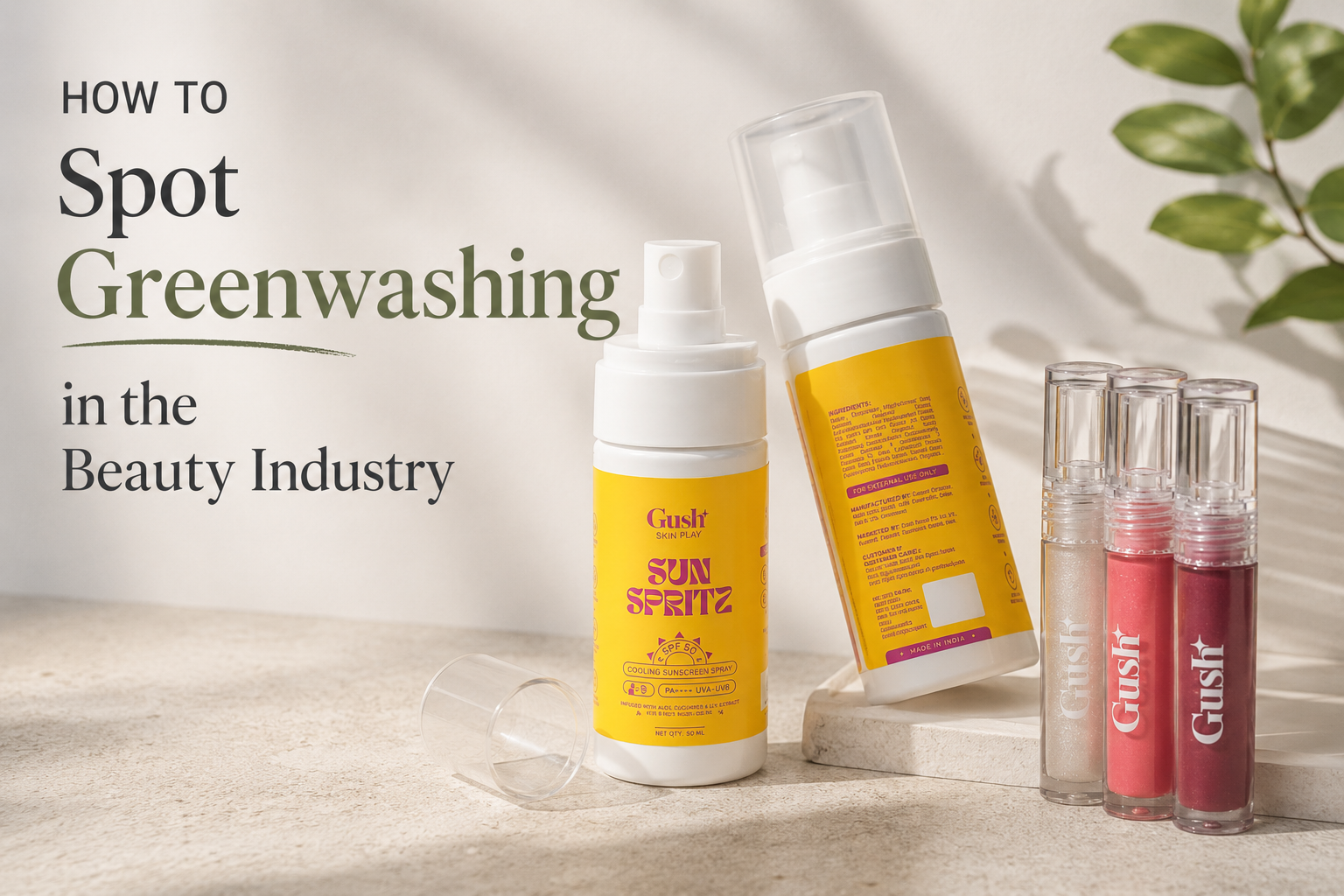
How to Spot Greenwashing in the Beauty Industry
Clean beauty. Green beauty. Eco-friendly. Natural. Sustainable. Cruelty-free. Planet-kind. These words are everywhere in beauty right now. And most of them mean nothing without evidence behind them.
Greenwashing is when a brand uses environmental or ethical language to appear more responsible than it actually is. It is one of the most common forms of misleading marketing in consumer products today, and the beauty industry is one of the worst offenders.
This guide teaches you to read past the language and find the substance — what real claims look like, what hollow ones look like, what certifications actually verify, and how Gush Beauty approaches these commitments differently.
What Greenwashing Is
Greenwashing is not always intentional deception. Sometimes it is the result of vague language that sounds good but has not been verified. Sometimes it is deliberate. Either way, the effect on the consumer is the same: you believe you are making an ethical choice when you may not be.
In beauty specifically, greenwashing shows up across several distinct categories — environmental claims about packaging, ingredients, and manufacturing; ethical claims about animal testing and labour practices; and health claims about ingredients and formulation standards. Each category has its own patterns of genuine claims and misleading ones.
Is greenwashing illegal?
Some forms of greenwashing breach advertising standards and consumer protection laws in various countries. Claims that are demonstrably false or that use certifications that do not exist can result in regulatory action. But many greenwashing claims operate in grey areas of vague, technically deniable language that is difficult to regulate. The best protection as a consumer is understanding what specific language actually means and what verification exists behind it.
What Greenwashing Looks Like in Practice
Emotional Language Without Evidence
This is the most common form. Phrases like we love the planet, kind to the earth, made with care for nature, conscious beauty, and planet-friendly appear across marketing and packaging without any specific claim attached to them. These are values statements, not evidence statements. A brand that loves the planet might also use non-recyclable packaging, source ingredients unsustainably, or test on animals. The emotional language makes no specific, verifiable claim and should not influence purchasing decisions on its own.
Green Packaging as a Proxy for Ethical Practices
A brand that shifts from plastic to recycled packaging, uses green colour schemes, and displays leaf motifs on its products is making environmental choices about packaging. It is not making any claim about ingredient safety, animal testing, labour practices, or formulation standards. Packaging is one small part of a brand's total environmental and ethical footprint. Treating sustainable packaging as evidence of broader ethical commitment is a common consumer error that greenwashing marketing actively encourages.
Vague Certifications or Self-Created Logos
Some brands create their own certification-looking logos — clean beauty seals, eco-approved badges, and similar marks — that appear to indicate third-party verification but are actually self-awarded. There is no independent body behind them, no criteria to meet, and no audit conducted.
A real certification logo from a recognised body includes the name of the organisation, can be verified on the organisation's official website, and was awarded based on independently assessed criteria.
Highlighting One Positive Attribute While Hiding Others
A brand that prominently advertises vegan formulas while being tested on animals. A product that advertises recyclable packaging while containing ingredients associated with environmental harm. A natural ingredient list that obscures a manufacturing process with a significant carbon footprint. This is the practice of emphasising one genuine positive while directing attention away from significant negatives. It is not technically false but it is designed to create a misleading overall impression.
Cruelty-Free Claims Without Verification
Cruelty-free is not a regulated term in India or in most countries. Any brand can print it on packaging. Without third-party certification from Leaping Bunny or PETA's Beauty Without Bunnies programme, or without specific, auditable policy statements covering both finished products and ingredients, a cruelty-free claim is self-reported and unverified.
For more on how to verify cruelty-free claims specifically, the Cruelty-Free Beauty Explained post covers this in detail.
What Real Ethical Claims Look Like
Specific and Verifiable Language
A genuine claim names exactly what is being claimed. "Not tested on animals by us or third parties on our behalf at any stage of production, including ingredients, in any market we sell in" is a specific, verifiable claim. "We are cruelty-free" is not. The more specific the language, the more likely it reflects a genuine commitment rather than a marketing posture. Specificity creates accountability. Vagueness avoids it.
Third-Party Certification From Recognised Bodies
Real certifications from recognised independent bodies are the strongest signal available to consumers. In cruelty-free beauty, Leaping Bunny and PETA's Beauty Without Bunnies are the major ones. In organic certification, COSMOS and USDA Organic are recognised standards. In sustainability, B Corp certification covers a broad set of social and environmental criteria and is considered one of the most comprehensive available.
Certifications from bodies without publicly available criteria, audit processes, or verifiable membership lists are not meaningful signals. Check the certifying body, not just the logo.
Ingredient Transparency
A brand committed to clean and ethical formulation publishes its full ingredient lists, explains why certain ingredients are included or excluded, and updates this information when formulas change. The ingredients are disclosed on the packaging and on the product page, not buried in a document linked from a footer.
Gush Beauty publishes full ingredient lists across all products and maintains a clean formulation standard explained on the Clean 2.0 page. This is the kind of ingredient transparency that distinguishes a genuine clean beauty commitment from a claim.
Market and Supply Chain Transparency
A brand that is genuinely cruelty-free and ethical addresses the markets it sells in, its manufacturing partners, and its ingredient suppliers. This information is not always publicly disclosed in full, but a genuinely committed brand will answer direct questions about it and will not be evasive when the topic comes up.
Questions to Ask Before Buying
When a product makes environmental or ethical claims, a short list of questions helps you quickly assess whether the claim is substantive.
What specifically is being claimed? Broad language with no specifics is a signal to look further.
Who is verifying it? Self-reported claims are less reliable than third-party certified ones. Look for the certifying organisation and check that they are real.
Does the claim cover the full picture? A cruelty-free claim that covers only the finished product and not the ingredients is an incomplete one. A sustainable packaging claim that says nothing about ingredients or manufacturing is a partial one.
Is the information easy to find? Brands with genuine commitments make this information accessible. Brands with marketing postures make it hard to find beyond the front-of-pack language.
Is the language specific or emotional? Specific, technical, and verifiable language indicates a genuine commitment. Emotional, values-based language without specifics indicates a marketing decision.
How do I verify a brand's sustainability claims quickly?
Look for certification logos from recognised bodies and verify them on the certifying organisation's website. Check the brand's website for a specific sustainability or ethics page with published policy language. Look at independent reviews and investigative journalism that covers brand claims rather than brand marketing. A few minutes of searching beyond the brand's own materials is usually enough to distinguish genuine commitments from surface-level claims.
How Gush Beauty Approaches These Standards
Gush Beauty is 100 percent vegan and cruelty-free across every product in the range. The vegan commitment means no animal-derived ingredients in any formula. The cruelty-free commitment means no animal testing at any stage of development or production.
The formulation standard is explained in detail on the Clean 2.0 page. This covers the specific ingredients excluded from Gush Beauty formulations and the rationale behind those exclusions. It is published publicly rather than available only on request, which is the standard approach for a genuine clean formulation commitment.
Every product in the Skin Play collection, Face collection, Lips collection, Eyes collection, and press-on nail collection meets the same standard with no product-by-product exceptions.
Frequently Asked Questions
Is natural the same as clean in beauty?
No. Natural means the ingredients are derived from natural sources rather than synthetic ones. Clean means the formula excludes specific ingredients considered harmful or controversial, regardless of whether they are natural or synthetic. Some natural ingredients are excluded from clean beauty formulations because they are harmful. Some synthetic ingredients meet clean beauty standards because they are safe and well-understood. Natural and clean overlap but are not the same thing.
Are all cruelty-free brands also vegan?
No. Cruelty-free means no animal testing. Vegan means no animal-derived ingredients. A brand can be one without the other. A cruelty-free brand can still use beeswax, lanolin, or carmine in formulas. A vegan brand can have products that were tested on animals. Gush Beauty is both cruelty-free and vegan across the entire range.
What is a B Corp certification and does it mean a brand is ethical?
B Corp certification from B Lab is a comprehensive assessment of a company's social and environmental performance, accountability, and transparency. It covers workers, community, environment, and governance. It is considered one of the most rigorous and comprehensive ethical certifications available for businesses. A B Corp certification is a strong positive signal, though no single certification covers every possible ethical consideration.
How do I find out if a beauty brand's sustainability claims are genuine?
Check for third-party certifications from recognised bodies. Look for specific, detailed policy language on the brand's own website covering exactly what is claimed. Check independent investigative sources and databases that track brand claims against verified evidence. Ask the brand directly about specific aspects of their supply chain or practices. Genuine commitment tends to be accompanied by detailed, accessible information. Greenwashing tends to be accompanied by emotional language and limited specifics.
Does buying from ethical brands actually make a difference?
Yes. Consumer purchasing decisions signal market demand. When ethical brands grow because consumers choose them consistently, other brands are commercially incentivised to raise their own standards. The expansion of genuinely cruelty-free, vegan, and clean beauty options across all price points over the past decade is directly tied to sustained consumer preference for these products. Individual choices aggregate into market-level change over time.
Is sustainable packaging the most important ethical factor to consider in beauty?
It is one factor among several. Packaging is visible and communicable, which is why it gets emphasised in marketing. But ingredient sourcing, animal testing practices, labour conditions in manufacturing, and formulation safety are all meaningful ethical dimensions of a beauty brand's practices. Evaluating only packaging gives an incomplete picture. A brand with fully recycled packaging that tests on animals or uses harmful ingredients is not a genuinely ethical choice.
How do I shop ethically in beauty without spending hours researching every brand?
Build a working list of verified brands that meet your standards. Use regularly updated databases for cruelty-free and vegan verification. Focus your research on new-to-you brands rather than ones you already trust. And look for brands like Gush Beauty where the entire range meets the same standard, so individual product checking is not required. Over time, ethical shopping becomes faster as your knowledge of verified brands grows.
Final Thoughts
Greenwashing works because the language is designed to feel trustworthy. The more you understand what real claims look like and what hollow ones look like, the less effective that language is. Specific beats vague. Certified beats self-reported. Transparent beats evasive. These three principles applied to any beauty purchase help you separate genuine ethical commitment from marketing posture.
Explore everything at gushbeauty.com. Read the formulation commitment on the Clean 2.0 page. Browse the full range by category at Skin Play, Face, Lips, Eyes, and press-on nails. Check the Bundles and Sets for cost-effective ways to build your routine.

From Office to Party: Press-On Nail Styles for...
Oct 19, 2026

Press-On Nails for Small Nail Beds: How to...
Oct 16, 2026

Press-On Nails for Weddings: How to Choose a...
Oct 12, 2026

Almond vs Round vs Coffin Nails: How to...
Oct 09, 2026

How to Choose the Right Press-On Nail Size...
Oct 05, 2026

Answers to the Most Confusing Beginner Beauty Questions
Sep 28, 2026

The Best Gush Beauty Products for a Minimal...
Sep 25, 2026

Beauty Trends That Look Great On Camera and...
Sep 21, 2026

Beauty Hacks That Make Your Makeup Last from...
Sep 18, 2026

Cruelty-Free Beauty vs Vegan Beauty: What Is the...
Sep 14, 2026