Gift Sets
 Fragrances
 Whip Lush
 BYOB Sale

 Eye Like Options
 Glow Getter
 Dart Its
 Stacked In Your Favour
 Bundles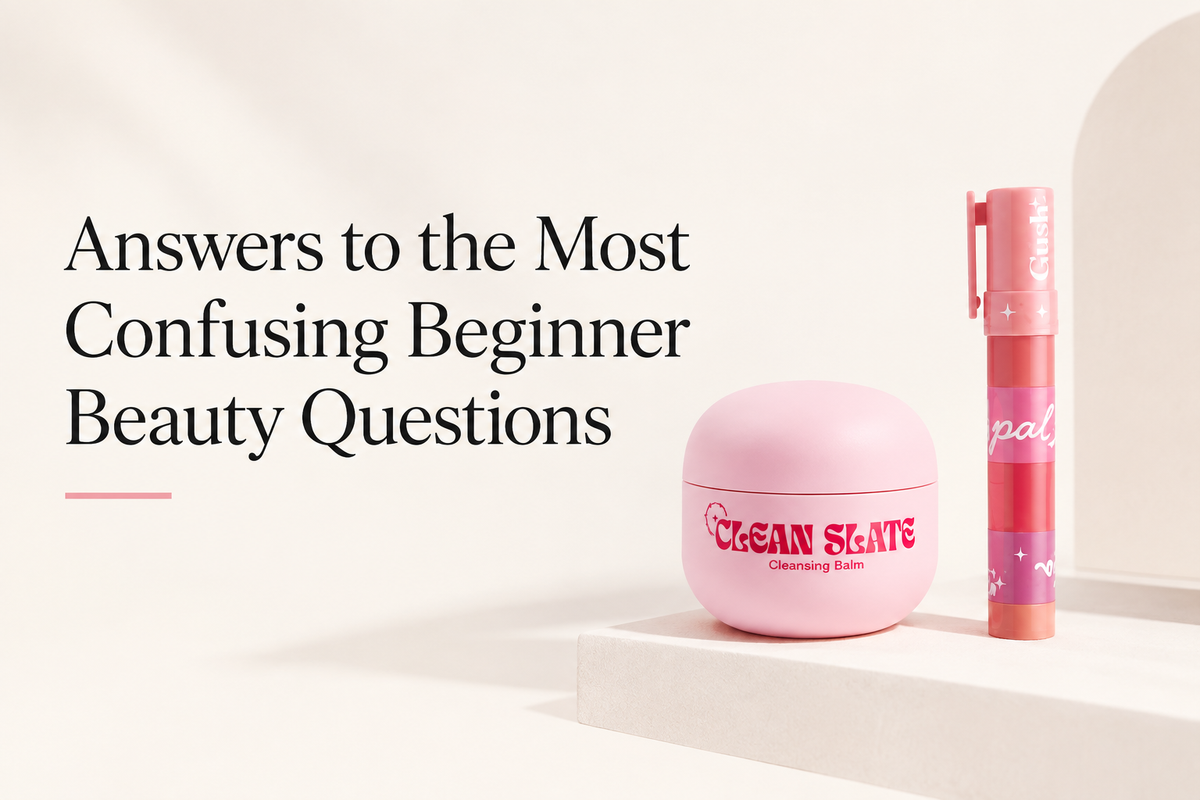
Answers to the Most Confusing Beginner Beauty Questions
Starting out in beauty is confusing.
Not because the information does not exist. Because there is too much of it, it often contradicts itself, and a lot of it assumes you already know things you are trying to find out.
This guide cuts through that. Every question here is one that genuinely confuses beginners. The answers are as direct and simple as possible, without jargon, without assuming prior knowledge, and without making a simple answer complicated.
Gush Beauty products are referenced where they give a concrete starting point for each answer.
Skincare Questions
What is the difference between a cleanser, a toner, and a serum?
A cleanser removes what is on your skin. Oil, makeup, sunscreen, dirt, and dead cells from the surface. It is the reset step. The Clean Slate Cleansing Balm is a cleanser that also removes makeup and SPF in one step.
A toner is applied after cleansing. Modern toners hydrate, balance the skin's pH after cleansing, and prepare the skin to absorb what comes next. They are optional but useful.
A serum is a concentrated treatment product. It contains active ingredients at higher levels than most moisturisers. Different serums address different concerns: hydration, brightening, acne, and early ageing. A serum goes on after toner and before moisturiser.
The order matters: cleanse first, tone second, serum third, moisturise fourth, SPF last.
What does non-comedogenic mean?
Non-comedogenic means the product is formulated not to block pores. Comedones are clogged pores, the technical name for blackheads and whiteheads. A non-comedogenic product is less likely to contribute to congestion and breakouts.
This label is particularly relevant for people with oily or acne-prone skin who are concerned about products making breakouts worse. It is not a guarantee that a product will not cause any individual person to break out, because skin reacts differently to different formulations. But it is a useful signal when choosing base products, sunscreens, and moisturisers for congestion-prone skin.
Do I need to use a different moisturiser day and night?
Not necessarily. A single good moisturiser can work for both. The reason people use different morning and evening moisturisers is that morning moisturiser is typically lighter to layer comfortably under SPF and makeup, while evening moisturiser can be richer because it does not need to layer under anything and skin benefits from more intensive hydration overnight.
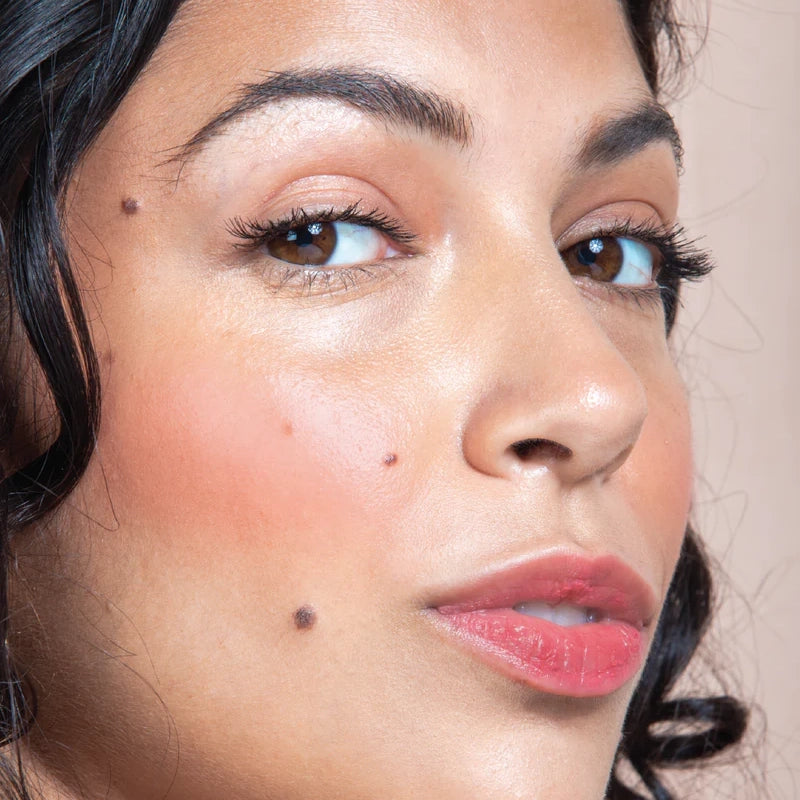
The Glow Getter Illuminating Moisturiser works for both morning and evening use. In the morning, a lighter application under SPF. In the evening, a slightly more generous application on damp skin for overnight hydration.
Why does my skin feel tight after washing?
Tight skin after cleansing usually means the cleanser is too stripping. It is removing the natural oils from the skin along with the dirt and makeup. A gentle, non-stripping cleanser leaves the skin feeling clean and comfortable after rinsing, not tight, dry, or squeaky.
If your skin feels tight after using your current cleanser, it is too harsh for your skin type. The Clean Slate Cleansing Balm cleanses thoroughly without stripping, leaving skin clean and comfortable rather than tight.
What is the skin barrier and why does everyone talk about it?
The skin barrier is the outermost layer of the skin. It keeps moisture in and external irritants, bacteria, and pollutants out. When the barrier is healthy, skin looks and feels balanced, comfortable, and resilient. When it is damaged, skin feels sensitive, reactive, and either very dry or compensating with excess oil.
Common causes of barrier damage: over-exfoliating, using too many active ingredients at once, using products that are too harsh for your skin type, and not moisturising consistently.
Protecting the barrier means cleansing gently, moisturising regularly, not over-exfoliating, and applying SPF daily to prevent UV damage to the skin surface.
Makeup Questions
What is the difference between foundation, tinted moisturiser, and BB cream?
These are all base products that even skin tone, but they differ in coverage level and texture.
Tinted moisturiser is the lightest. It is primarily a moisturiser with a small amount of pigment. Very sheer coverage, skin-like finish, easy to apply.
BB cream, which stands for blemish balm or beauty balm, offers slightly more coverage than a tinted moisturiser and often contains skincare ingredients like SPF and hydrating agents. Coverage is still light to medium.
Foundation offers the widest range of coverage, from sheer to full. It is the most customisable base product and the one that requires the most technique to apply well.
For beginners, starting with a tinted moisturiser or BB cream before moving to foundation gives you coverage without the application challenges of a heavier formula.
What does setting makeup mean and do I actually need to do it?
Setting means applying something over your finished makeup to lock it in place and extend how long it holds.
Setting powder is the most common setting product. It absorbs oil, prevents makeup from sliding, and reduces creasing. Apply it with a fluffy brush over areas that tend to get shiny or where your concealer creases.
Setting spray is a fine mist applied over completed makeup. It binds the makeup together and helps it feel more like skin. It can also prevent that dry, powdery feeling from over-setting with powder.
Whether you need to set depends on how long your makeup holds without it and where it breaks down first. If your concealer creases by midday, targeted powder helps. If your makeup slides off after a few hours, a setting step is worth adding.
How do I know if a foundation shade is wrong?
A wrong foundation shade usually makes itself obvious in daylight, even if it looked fine in artificial light. Too light: the face looks greyer or paler than the neck. Too dark: the face looks noticeably darker than the neck. Wrong undertone: the face looks orange, pink, or ashy even when the depth appears right.
Always check your foundation match in natural daylight near a window before committing. Swatch on the jawline, not the hand, because the hand and face are often different tones.
What is the right order to apply makeup products?
From lightest to heaviest texture, generally.
Skincare first. SPF last in skincare.
Then makeup: primer if you use one, foundation or tinted base, concealer on specific areas, setting powder where needed, colour products like blush and eyeshadow, liner, mascara, and lip colour last.
Within this order, a few specific rules: concealer after foundation because it is a heavier product and easier to apply precisely once the base is set. Mascara last because it is the most likely to smudge during other application steps. Lip colour last because it is easiest to check against the completed look.
What does setting spray do that powder does not?
Powder absorbs oil and sets the physical product on the skin surface. It mattifies and holds things in place but can leave a powdery, flat finish if too much is used.
Setting spray binds all the makeup layers together with a fine mist. It gives a more skin-like, seamless finish and prevents the powdery appearance from heavy setting. It also works better than powder alone for dry skin types because it adds a slight moisture element rather than absorbing it.
For most beginners, targeted powder under the eyes and over the T-zone plus a setting spray over the finished face gives the most reliable combination of longevity and natural finish.
Product Questions
What is the difference between an eyeshadow and a highlighter?
Eyeshadow is formulated for the eyelid area. It comes in a range of finishes from matte to glitter and is designed to adhere to the eyelid skin throughout the day.
Highlighter is formulated for the high points of the face: tops of the cheekbones, brow bone, cupid's bow, inner corners of the eyes, and the bridge of the nose. It is typically shimmer, glow, or metallic finish and is designed to catch light at the face's most prominent points.
In practice, many people use pale shimmer eyeshadow as a highlighter on the brow bone and inner corner, and some highlighter formulas can be used on the lid. There is overlap in use but they are formulated for different primary purposes.
What is a primer and is it always necessary?
A primer is applied between skincare and makeup. It can fill pores and smooth texture, extend how long makeup holds, help formulas blend more easily, and control oil.
It is not always necessary. If your makeup holds well and looks the way you want without a primer, skip it. If your makeup breaks down within a few hours, a primer matched to your concern — mattifying for oily skin, hydrating for dry skin, pore-filling for visible pores — can make a meaningful difference.
For most beginners, ensuring your moisturiser is fully absorbed before applying foundation is a simpler first step than adding a primer.
What is the difference between a lip liner and a lip pencil?
They are essentially the same product. Both are pencil-format lip products designed to line the perimeter of the lips and fill them in as a colour base. Some brands use both terms for the same type of product. If there is any difference, a lip liner tends to be described as drier and more precise for outlining, while a lip pencil may be slightly creamier. In practice, any pencil-format lip product designed for the lip area can be used as both an outline and a fill-in base.
The 5-in-1 Pen Pal Twistable Multi Stick functions as both in one product with a formula that works well for the fill-in technique that extends lip colour wear significantly.
What is the difference between a lip gloss, a lip oil, and a lip balm?
A lip gloss is primarily a shine product. It gives a high-gloss, reflective finish with varying amounts of colour. Formula is typically gel or polymer-based.
A lip oil is an oil-based formula that conditions the lips with nourishing ingredients while also providing shine and colour. The texture is lighter than gloss and the conditioning effect is more significant. The Juicy Lip Oil and Glaze Lip Oil Gloss are both lip oils from Gush Beauty.
A lip balm is primarily a treatment product. It moisturises and protects the lips rather than providing significant colour or shine. The Butter Balm Hybrid Gloss Balm sits between a balm and a gloss, providing both conditioning and a glossy finish in one product.
Habit and Routine Questions
How long should a skincare routine take?
A basic routine takes about three to five minutes morning and evening. Cleanser, moisturiser, and SPF in the morning. Cleanser and moisturiser at night. Everything else is additional and optional.
If your routine takes significantly longer, assess whether each step is genuinely contributing something that the steps around it are not. A five-minute routine followed consistently every day delivers better results than a twenty-minute routine followed occasionally.
How do I know if a product is working?
Give it four to six weeks of consistent use before assessing. Most active ingredients take at least one full skin cell turnover cycle, approximately four weeks, to produce visible results. Moisturiser and SPF show benefit more quickly in terms of skin comfort and barrier protection, but visible changes in pigmentation, texture, and tone take longer.
Track changes with a baseline photograph taken in the same lighting at the start and again four weeks later. Skin changes are gradual enough to be invisible day-to-day but visible over weeks when compared objectively.
Is it bad to change products frequently?
Yes, usually. Changing products before they have had time to show results means you never give any one product the chance to work. It also makes it impossible to identify which product caused any improvement or any reaction because too many variables are changing at once.
Introduce one new product at a time. Give each product at least four weeks before assessing. Only change if you see a clear negative reaction, not because you are impatient for faster results.
Frequently Asked Questions
What is the very first skincare product a beginner should buy?
A sunscreen. It protects the skin from the damage that causes most of the concerns people try to address with other skincare products later. The UV U Later SPF 50 Sunscreen Serum is SPF 50 PA+++ broad spectrum in a formula that feels like nothing on the skin. Start here before any serum, treatment, or active ingredient.
Do I need to spend a lot on skincare and makeup to get results?
No. Consistency and technique matter more than price for most people. A well-chosen affordable sunscreen applied every day delivers better results than an expensive one skipped frequently. A lip liner technique used with a mid-range liner holds longer than a luxury lip product applied without prep. Start with products suited to your skin and budget and focus on using them consistently.
What is the most common mistake beginners make in skincare?
Skipping sunscreen. Nothing else in a skincare routine is undermined by skipping steps the way SPF is. Every active, every treatment, and every moisturiser delivers better results on skin that is consistently protected from daily UV exposure. It is the one step that genuinely cannot be compensated for by anything else.
What is the most common mistake beginners make in makeup?
Using too much product. More foundation, more blush, more eyeshadow does not produce better results. It produces a heavier, less natural finish that breaks down faster through the day. Less product applied with good technique consistently looks more polished than more product applied without intention. Start with a fraction of what you think you need and build from there.
Do I need to follow every step of a multi-step routine?
No. A cleanser, moisturiser, and SPF in the morning and a cleanser and moisturiser at night is a complete effective routine. Everything beyond this is optional and adds value only if your specific skin has the concern the product addresses. More steps is not automatically better. The right steps for your skin, followed consistently, is what produces results.
Where can I find all Gush Beauty beginner products in one place?
Browse the Face collection, Lips collection, Eyes collection, and Skin Play collection at Gush Beauty. The Bundles and Sets offer value combinations ideal for building a first kit. The Meet Gush page gives background on the brand's approach and values.
Final Thoughts
Beauty does not have to be complicated.
A few products chosen with intention, applied consistently with decent technique, and suited to your skin type will always outperform an elaborate routine followed haphazardly.
Start simple. Build only when you understand what you have. Ask questions when something is confusing rather than assuming the answer.
Explore the full Gush Beauty range by category at Skin Play, Face, Lips, and Eyes. Check the Bundles and Sets for cost-effective starting points.

From Office to Party: Press-On Nail Styles for...
Oct 19, 2026

Press-On Nails for Small Nail Beds: How to...
Oct 16, 2026

Press-On Nails for Weddings: How to Choose a...
Oct 12, 2026

Almond vs Round vs Coffin Nails: How to...
Oct 09, 2026

How to Choose the Right Press-On Nail Size...
Oct 05, 2026

Answers to the Most Confusing Beginner Beauty Questions
Sep 28, 2026

The Best Gush Beauty Products for a Minimal...
Sep 25, 2026

Beauty Trends That Look Great On Camera and...
Sep 21, 2026

Beauty Hacks That Make Your Makeup Last from...
Sep 18, 2026

Cruelty-Free Beauty vs Vegan Beauty: What Is the...
Sep 14, 2026