Gift Sets
 Fragrances
 Whip Lush
 BYOB Sale

 Eye Like Options
 Glow Getter
 Dart Its
 Stacked In Your Favour
 Bundles
Ingredient Myths in Skincare and Makeup
There is a lot of noise around beauty ingredients.
Some ingredients get a bad reputation they do not deserve. Others get praised for things they cannot actually do. And most people are left confused about what is actually safe, effective, and worth their money.
This guide clears up the most common ingredient myths in skincare and makeup so you can read labels with confidence and stop second-guessing your routine.
Why Ingredient Myths Are a Problem
When you believe the wrong things about ingredients, you make decisions based on fear or hype rather than facts.
You might avoid a perfectly safe ingredient because someone online said it was harmful. Or you might keep using something that is not working because it has a trendy label on it.
Understanding what ingredients actually do helps you build a routine that works for your skin, not against it.
Myth 1: Natural Ingredients Are Always Safe
This is one of the most common and most misleading beliefs in beauty.
Natural does not automatically mean safe. Poison ivy is natural. So is arsenic. Many natural ingredients cause allergic reactions, skin irritation, and photosensitivity in certain skin types.
Essential oils, for example, are natural but they are among the most common causes of contact dermatitis. Citrus extracts can make skin sensitive to sunlight. Certain plant extracts clog pores.
The truth is that the safety of an ingredient depends on its concentration, formulation, and how your skin responds to it. Not on whether it came from a plant or a lab.
Always patch test new products regardless of whether the ingredients are natural or synthetic.
Myth 2: Synthetic Ingredients Are Always Harmful
The flip side of the first myth is just as wrong.
Synthetic does not mean toxic. Many of the most effective and well-researched skincare ingredients are lab-made. Hyaluronic acid, niacinamide, and most vitamin C derivatives used in skincare are synthesised in a lab. They are also some of the safest and most proven ingredients available.
Lab-made ingredients are often more stable, more consistent, and better absorbed by the skin than their natural equivalents. They go through rigorous testing before they end up in a product.
Judge an ingredient by the evidence behind it, not by where it was made.
Myth 3: Parabens Are Dangerous
Parabens became a major beauty villain a few years ago and the fear stuck around long after the science was reviewed.
The concern came from a 2004 study that found parabens in breast tissue samples. This got widely reported as proof that parabens cause cancer. But the study did not establish any link between parabens and cancer. It simply detected their presence.
Since then, multiple regulatory bodies including the European Commission's Scientific Committee have reviewed the evidence and concluded that parabens used in cosmetics at approved concentrations are safe.
That said, many brands including Gush Beauty choose to formulate without parabens not because they are dangerous but because cleaner alternatives exist. Gush Beauty products are paraben-free as part of a broader commitment to formulating with better ingredients across the range. You can read more about this on the Clean 2.0 page.
The bottom line: current evidence does not support the claim that parabens in cosmetics are harmful. But choosing paraben-free products is a completely reasonable personal preference.
Myth 4: Hyaluronic Acid Hydrates Skin on Its Own
Hyaluronic acid is one of the most popular skincare ingredients right now and it genuinely works. But there is a common misunderstanding about how.
Many people think that applying hyaluronic acid directly to dry skin will hydrate it. In reality, hyaluronic acid is a humectant. It draws moisture from its surroundings and holds it in the skin. If your skin is very dry and the air around you is dry too, it can actually pull moisture from deeper layers of skin instead of drawing it in.
For hyaluronic acid to work properly, apply it to damp skin and follow with a moisturiser to seal it in. This traps the moisture and lets the ingredient do its job.
The Glow Getter 4-in-1 Illuminating Moisturiser is infused with niacinamide and skin-loving actives and works as a moisturiser that locks in hydration after your skincare steps. Applying it over your serums seals in the benefits of ingredients like hyaluronic acid rather than letting them evaporate.
Myth 5: Fragrance in Beauty Products Is Always Bad
Fragrance in beauty products is a genuinely mixed topic, which is why the myth around it has spread so widely.
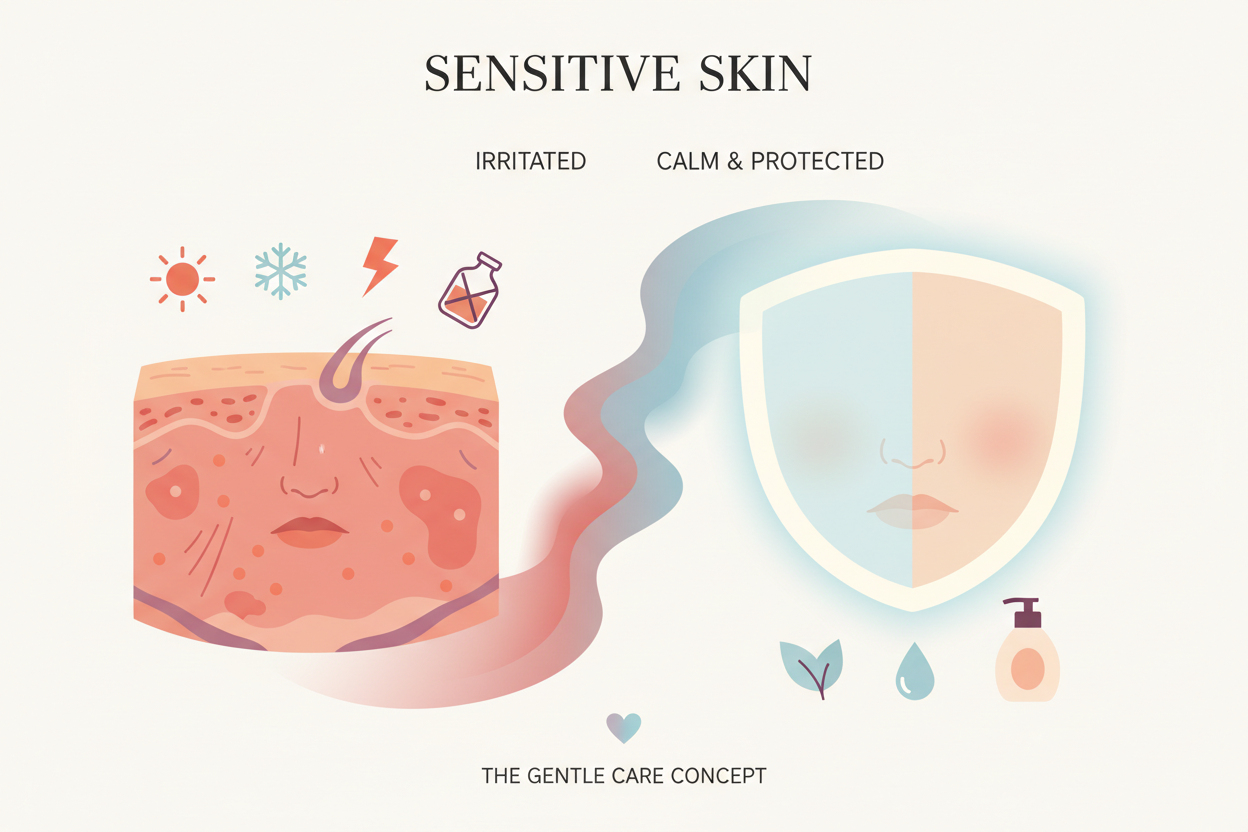
The truth is that fragrance can be problematic for some people, especially those with sensitive skin, skin conditions like eczema, or known fragrance allergies. For these people, fragrance-free products are a smart and important choice.
However, for most people with normal to combination skin, a small amount of fragrance in a rinse-off or low-exposure product like a body wash is unlikely to cause issues.
The problem is not fragrance itself. The problem is using high concentrations of synthetic fragrance in leave-on products on sensitive or reactive skin.
If your skin is sensitive, avoid fragrance in moisturisers, serums, and eye products. If your skin is not sensitive, a light fragrance in a well-formulated product is unlikely to be an issue.
Myth 6: SPF in Makeup Is Enough Sun Protection
This one is important and very commonly misunderstood.
SPF in foundation, BB cream, or a tinted moisturiser sounds convenient. But it rarely provides the protection the number suggests.
For SPF to work at its stated level, you need to apply a specific amount of product. Most people apply far less foundation or tinted moisturiser than is needed to achieve the SPF on the label. You would need to apply a very thick layer of SPF 30 foundation to actually get SPF 30 protection, and that is not how most people wear foundation.
SPF in makeup should be seen as a bonus, not a replacement. Always apply a dedicated sunscreen under your makeup first.
The UV U Later SPF 50 Sunscreen Serum is lightweight, absorbs fast, and sits well under makeup. It gives you real, reliable sun protection before your makeup even goes on.
Myth 7: More Ingredients Mean a Better Product
A long ingredient list does not equal a more effective product. In fact, the more ingredients a formula contains, the higher the chance of irritation, ingredient interactions, or dilution of active ingredients.
Some of the most effective skincare products have very short ingredient lists. A well-formulated product with five to eight ingredients that are well-chosen and properly dosed will often outperform a product with thirty ingredients that are not.
When reading a product label, focus on what the key actives are and whether they are present in a meaningful concentration. Do not judge a product by the length of its ingredient list.
Myth 8: Niacinamide and Vitamin C Cannot Be Used Together
This myth started because early studies showed that niacinamide and vitamin C could combine to form a compound called niacin, which causes skin flushing.
However, those studies used conditions that do not reflect real skincare use. At normal concentrations and in stable formulations, the reaction does not happen in any meaningful amount.
Modern formulations of both ingredients are designed to be stable and effective. Using niacinamide and vitamin C in the same routine is not a problem for most people.
If you are still cautious, apply them at different times of day. But there is no strong evidence to suggest this is necessary with current formulations.
Myth 9: Expensive Ingredients Are More Effective
Price does not equal performance in skincare.
Some of the most effective skincare ingredients, niacinamide, hyaluronic acid, glycerin, zinc oxide, are inexpensive to produce. Some of the most expensive ingredients in luxury skincare have very limited clinical evidence behind them.
Effectiveness comes from the right ingredient, at the right concentration, in the right formulation for your skin type. A well-made product at a mid-range price point will almost always outperform an overpriced product with a trendy but under-dosed hero ingredient.
Focus on ingredients with proven track records rather than marketing claims about rare or exotic additions.
Frequently Asked Questions
Are natural skincare ingredients always better than synthetic ones
No. Natural ingredients can cause irritation, allergic reactions, and photosensitivity. Synthetic ingredients are often more stable and better tested. Safety depends on the ingredient, its concentration, and how your skin responds to it.
Is fragrance in skincare products harmful
It depends on your skin type. For sensitive skin, fragrance in leave-on products can cause irritation. For most skin types, a small amount of fragrance in a well-formulated product is not a problem. Choose fragrance-free products if you have reactive or sensitive skin.
Do I still need sunscreen if my foundation has SPF
Yes. The amount of foundation most people apply is far less than what is needed to achieve the SPF stated on the label. Always apply a dedicated sunscreen before foundation for reliable sun protection.
Are parabens in cosmetics dangerous
Current evidence from multiple regulatory bodies shows that parabens used in cosmetics at approved levels are safe. Many brands choose to go paraben-free for cleaner formulations, not because parabens have been proven harmful.
Can I use niacinamide and vitamin C together
Yes. At normal concentrations and in modern formulations, there is no significant interaction between niacinamide and vitamin C. You can use both in the same routine without concern.
Final Takeaway
Ingredient myths make skincare feel more complicated than it needs to be. Most fears around ingredients come from misread studies, oversimplified headlines, or marketing designed to create confusion.
The best approach is simple. Focus on proven ingredients. Check the evidence before believing a claim. Patch test new products. And choose brands that are honest and transparent about what goes into their formulations.
When you understand what you are actually putting on your skin, your routine becomes easier to build, easier to trust, and easier to stick with.
Also Read:

From Office to Party: Press-On Nail Styles for...
Oct 19, 2026

Press-On Nails for Small Nail Beds: How to...
Oct 16, 2026

Press-On Nails for Weddings: How to Choose a...
Oct 12, 2026

Almond vs Round vs Coffin Nails: How to...
Oct 09, 2026

How to Choose the Right Press-On Nail Size...
Oct 05, 2026

Answers to the Most Confusing Beginner Beauty Questions
Sep 28, 2026

The Best Gush Beauty Products for a Minimal...
Sep 25, 2026

Beauty Trends That Look Great On Camera and...
Sep 21, 2026

Beauty Hacks That Make Your Makeup Last from...
Sep 18, 2026

Cruelty-Free Beauty vs Vegan Beauty: What Is the...
Sep 14, 2026