Gift Sets
 Fragrances
 Whip Lush
 BYOB Sale

 Eye Like Options
 Glow Getter
 Dart Its
 Stacked In Your Favour
 Bundles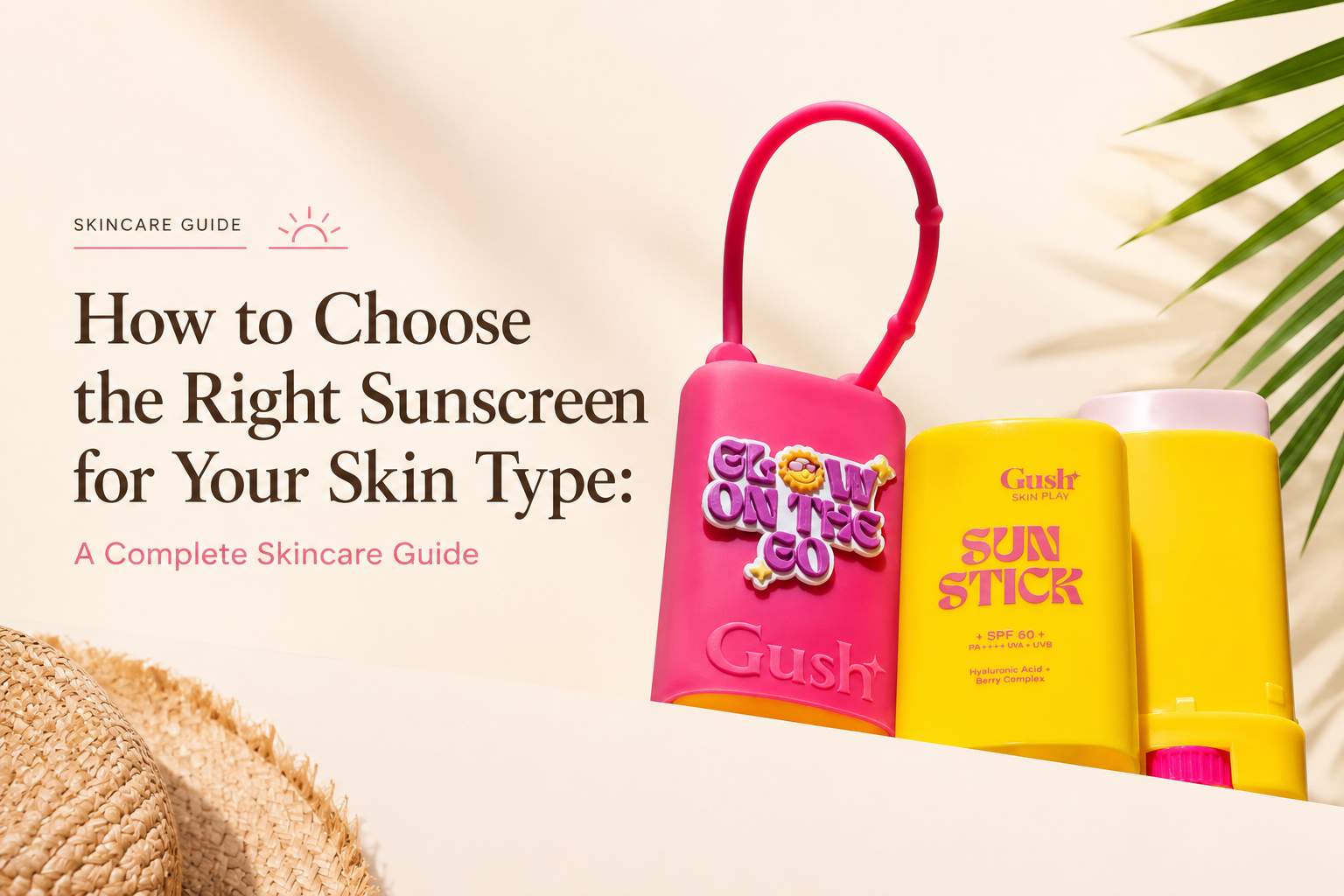
How to Choose the Right Sunscreen for Your Skin Type: A Complete Skincare Guide
Not all sunscreens work the same way on every skin.
A formula that feels perfect on dry skin can feel heavy and greasy on oily skin. A lightweight gel that works well for oily skin can leave dry skin feeling tight and uncomfortable. This mismatch is one of the biggest reasons people stop using sunscreen regularly. The product they tried did not suit their skin, so they assumed sunscreen in general was not for them.
The truth is simpler. You just need the right formula for your skin type.
This guide breaks down exactly what to look for based on your skin, with options from Gush Beauty to help you find the one that actually works for you.
Why Skin Type Matters for Sunscreen
Sunscreen sits on your skin all day. Unlike a serum that absorbs and disappears, sunscreen needs to stay on the surface to do its job. This means texture, finish, and formula matter as much as the SPF number itself.
A sunscreen that suits your skin type feels comfortable enough that you actually want to wear it every day. One that does not suit your skin type gets skipped, and a skipped sunscreen offers zero protection no matter how good the SPF number looks on the label.
Does skin type affect how well sunscreen works?
Skin type does not change how much UV protection a sunscreen provides. It changes how comfortable that sunscreen feels and how likely you are to wear it consistently. A sunscreen you skip because it feels wrong on your skin gives you no protection at all. Choosing the right formula for your skin type is really about choosing the one you will actually use every single day.
Sunscreen for Oily and Acne-Prone Skin
Oily skin needs a lightweight, non-comedogenic formula that controls shine without adding more oil to the surface.
Look for gel or fluid textures rather than thick creams. Avoid heavy, occlusive formulas that can trap oil and contribute to congestion. A matte or semi-matte finish helps control midday shine without needing constant blotting.
The UV U Later SPF 50 Sunscreen Serum is well suited to oily and acne-prone skin. Its serum texture absorbs quickly and adds no greasiness or heaviness to the skin. It sits comfortably under makeup without sliding by midday, which is one of the most common frustrations people with oily skin have with sunscreen.
Why does sunscreen make my oily skin worse?
This is usually a formula issue rather than a sunscreen issue. Heavy, cream-based sunscreens can sit on top of oily skin and contribute to a shiny, congested appearance. Switching to a lightweight, serum or gel-based formula like the UV U Later SPF 50 Sunscreen Serum usually resolves this completely. The product itself is not the problem. The wrong texture for your skin type is.
Sunscreen for Dry Skin
Dry skin benefits from a sunscreen with some hydrating properties, or one that layers comfortably over a rich moisturiser without pilling or feeling tacky.
Look for formulas described as hydrating or nourishing. Cream-based sunscreens can work well for dry skin if they do not feel heavy or sit unevenly.
For dry skin, apply the Glow Getter Illuminating Moisturiser first on slightly damp skin. Let it absorb fully. Then layer the UV U Later SPF 50 Sunscreen Serum on top. The serum texture glides smoothly over a well-moisturised base and does not feel drying, even though it is not a heavy cream itself.
Can a lightweight sunscreen work for dry skin?
Yes, if it is layered correctly. The hydration for dry skin should come from your moisturiser. The sunscreen on top only needs to protect, not moisturise. Applying a nourishing moisturiser first and a lightweight sunscreen second gives dry skin both the hydration it needs and the protection it needs without feeling heavy or tight.
Sunscreen for Combination Skin
Combination skin is oily in the T-zone and normal to dry on the cheeks. It is the most common skin type and the trickiest to match with a single formula, because a sunscreen too heavy for the T-zone can feel too light for the cheeks.
A lightweight, balanced formula is the safest choice. The UV U Later SPF 50 Sunscreen Serum works well for combination skin because the serum texture does not add heaviness to the oilier areas while still feeling comfortable on the drier parts of the face.
Should combination skin use different sunscreens on different areas of the face?
It is not necessary, though some people prefer this approach. Using one lightweight, balanced formula across the whole face is simpler and works well for most combination skin types. If your T-zone gets noticeably shinier by midday, a light dusting of translucent powder over the T-zone alone, on top of your sunscreen, helps manage this without needing a second product.
Sunscreen for Sensitive Skin
Sensitive skin reacts easily to fragrance, certain chemical filters, and harsh additives. Look for fragrance-free formulas with minimal ingredient lists.
Patch testing any new sunscreen before applying it to your full face is always a good idea for sensitive skin. Apply a small amount to your inner forearm, wait twenty-four hours, and check for any redness or irritation before using it on your face.
The UV U Later SPF 50 Sunscreen Serum is formulated without the common irritants that trigger reactions in sensitive skin, making it a suitable option to patch test for sensitive skin types.
What ingredients should sensitive skin avoid in sunscreen?
Fragrance is the most common irritant in sunscreens generally. Some chemical filters can also cause reactions in particularly reactive skin, though this varies significantly from person to person. If you have a known sensitivity, checking the full ingredient list before purchase and patch testing before full use are the two most reliable ways to avoid a reaction.
Sunscreen for Normal Skin
Normal skin is the most flexible skin type when it comes to sunscreen choice. Most formulas, including the UV U Later SPF 50 Sunscreen Serum, will work comfortably without needing any special adjustment.
The main thing normal skin needs to prioritise is consistency rather than formula matching. Find a sunscreen you genuinely enjoy applying every day, and the rest takes care of itself.
What to Look for Regardless of Skin Type
Some features matter for every skin type, no matter which formula you choose.
Broad spectrum protection is non-negotiable. This means the sunscreen protects against both UVA and UVB rays. A sunscreen without broad spectrum protection is only doing half the job.
SPF 30 is the minimum for daily indoor use. SPF 50 is better for outdoor activity or for anyone managing pigmentation concerns, which is common on Indian skin.
No white cast matters for every skin tone but especially for medium to deep Indian skin tones, where a white cast is more visible and more likely to discourage daily use. The UV U Later SPF 50 Sunscreen Serum leaves no cast on any skin tone.
A texture that absorbs quickly matters because a sunscreen that takes a long time to set is harder to fit into a morning routine and more likely to get skipped on busy days.
For reapplication during the day, regardless of skin type, the Sunscreen Stick is the most practical option. It applies cleanly over makeup without disturbing your base.
How to Test if a Sunscreen Suits Your Skin
Before committing to a full-size sunscreen, a short trial period tells you a lot.
Apply it for five to seven consecutive days as part of your normal routine. Pay attention to how your skin feels by midday. Watch for any new breakouts, increased oiliness, dryness, or irritation. Check how it performs under makeup if you wear it.
If your skin feels comfortable, looks the same or better than usual, and you find yourself wanting to apply it each morning without dreading the texture, it is a good match.
How long does it take to know if a sunscreen does not suit my skin?
Most reactions or mismatches show up within the first week of use. Breakouts caused by a comedogenic formula typically appear within five to seven days. Irritation from a fragrance or ingredient sensitivity usually appears within twenty-four to forty-eight hours. If you have used a sunscreen consistently for a week with no negative changes, it is very likely a good match for your skin.
Frequently Asked Questions
What is the best sunscreen for oily, acne-prone Indian skin?
A lightweight, non-comedogenic, gel or serum-based formula with broad spectrum SPF 50 protection works best for oily and acne-prone skin. The UV U Later SPF 50 Sunscreen Serum is formulated specifically with this texture in mind and does not contribute to congestion or shine.
Can I use the same sunscreen on my face and body?
Technically yes, but face-specific sunscreens are formulated to be lighter and less likely to clog facial pores. Body sunscreens are often thicker and more emollient, which works well on arms and legs but can feel heavy on the face. Using the UV U Later SPF 50 Sunscreen Serum for your face and a separate body sunscreen for exposed limbs is the better approach.
Does sunscreen need to match my foundation or moisturiser?
No. Sunscreen and foundation are entirely separate products with separate jobs. Sunscreen does not need to match your foundation shade. What matters is that the sunscreen sits well underneath your foundation without pilling, and that you apply enough of it for the SPF to be effective. The UV U Later SPF 50 Sunscreen Serum is designed to sit comfortably under makeup of any shade or formula.
How do I know if my sunscreen is causing breakouts?
Pay attention to where and when new breakouts appear. If they show up in areas where the sunscreen sits, the forehead, nose, and chin where T-zone congestion is most common, within a few days of starting a new sunscreen, the formula is likely too heavy or comedogenic for your skin. Switching to a lighter, serum-based formula like the UV U Later SPF 50 Sunscreen Serum often resolves this.
Is mineral sunscreen better than chemical sunscreen for sensitive skin?
Generally yes, mineral sunscreens using zinc oxide or titanium dioxide are considered gentler for sensitive and reactive skin because they sit on top of the skin rather than being absorbed. However, well-formulated chemical sunscreens without common irritants can also work well for sensitive skin. Patch testing is the most reliable way to know for certain rather than assuming based on formula type alone.
What SPF should combination skin use daily?
SPF 30 is the minimum for daily indoor use, and SPF 50 is recommended if you spend time outdoors or are managing any pigmentation concerns. Combination skin does well with SPF 50 broad spectrum formulas in a lightweight texture, like the UV U Later SPF 50 Sunscreen Serum, because it balances both the oilier and drier areas of the face without needing two separate products.
How often should I switch my sunscreen based on the season?
Many people find their skin shifts between seasons, oilier in summer and drier in winter, especially in regions with significant seasonal humidity changes. If your sunscreen feels too heavy in summer or not hydrating enough in winter, adjusting your moisturiser underneath is usually a better solution than switching sunscreens. The UV U Later SPF 50 Sunscreen Serum is lightweight enough to work consistently across seasons when paired with a moisturiser suited to the current weather.
Final Thoughts
The right sunscreen is not the one with the highest SPF number or the fanciest packaging. It is the one that feels comfortable enough on your specific skin that you actually wear it every single day.
Match the formula to your skin type. Test it for a week. Stick with what works.
Explore the Skin Play collection at Gush Beauty for the UV U Later SPF 50 Sunscreen Serum and the Sunscreen Stick. For combinations with other skincare essentials, check the Bundles and Sets.

From Office to Party: Press-On Nail Styles for...
Oct 19, 2026

Press-On Nails for Small Nail Beds: How to...
Oct 16, 2026

Press-On Nails for Weddings: How to Choose a...
Oct 12, 2026

Almond vs Round vs Coffin Nails: How to...
Oct 09, 2026

How to Choose the Right Press-On Nail Size...
Oct 05, 2026

Answers to the Most Confusing Beginner Beauty Questions
Sep 28, 2026

The Best Gush Beauty Products for a Minimal...
Sep 25, 2026

Beauty Trends That Look Great On Camera and...
Sep 21, 2026

Beauty Hacks That Make Your Makeup Last from...
Sep 18, 2026

Cruelty-Free Beauty vs Vegan Beauty: What Is the...
Sep 14, 2026