Gift Sets
 Fragrances
 Whip Lush
 BYOB Sale

 Eye Like Options
 Glow Getter
 Dart Its
 Stacked In Your Favour
 Bundles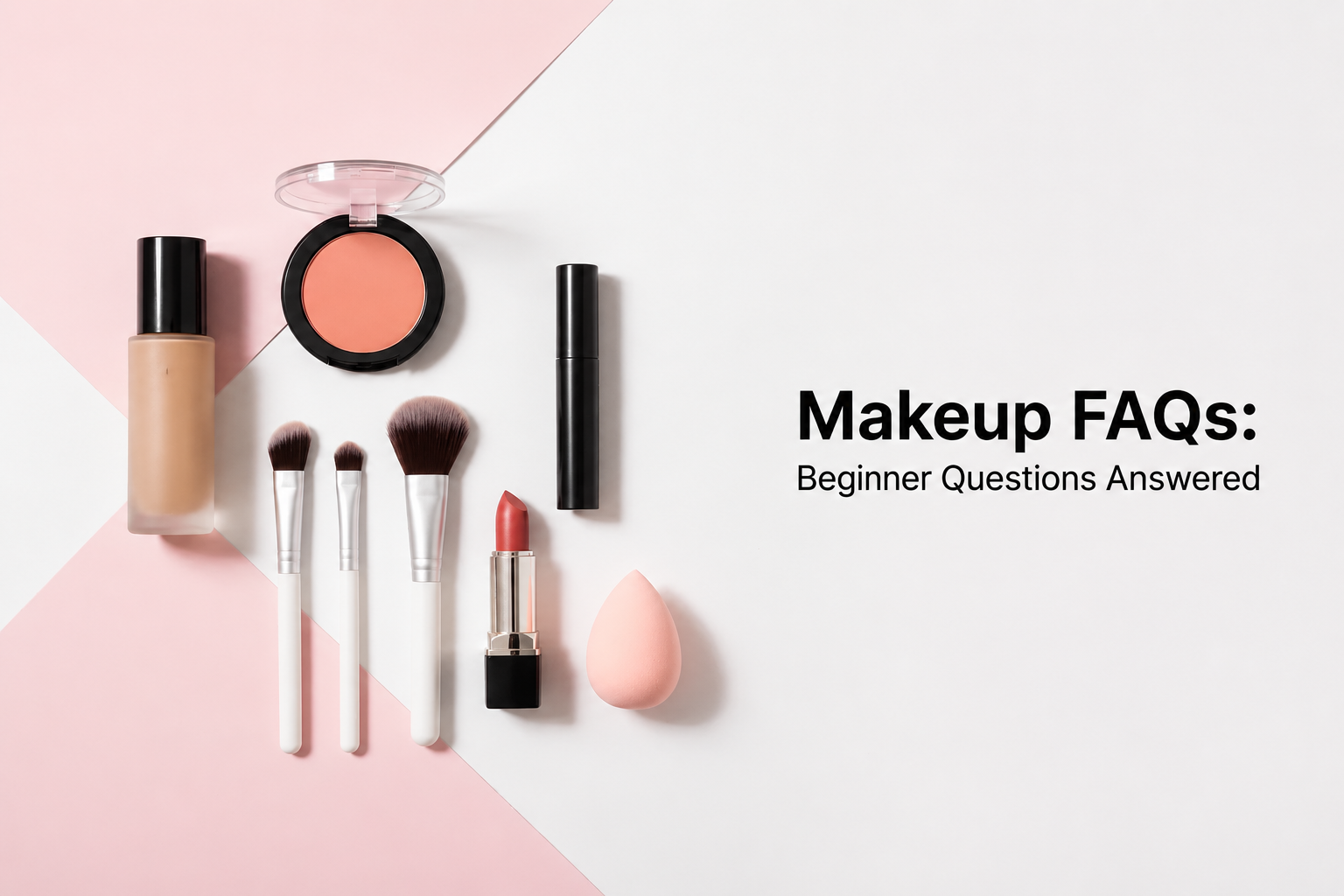
Makeup FAQs: Beginner Questions Answered
Starting out with makeup can feel overwhelming.
There are too many products. Too many steps. Too many conflicting opinions. And most tutorials assume you already know what a cut crease is or why you need a setting spray.
This guide does not assume anything. Every question here is one that real beginners ask. The answers are simple, direct, and practical. Where a Gush Beauty product fits, it is included with a link so you know exactly where to find it.
Start from the beginning. Build from there.
Getting Started
Where do I begin with makeup?
Start with three products. A lip colour or tinted balm, a mascara, and a cream blush. These three take under five minutes to apply, require almost no technique, and immediately change how put together you look.
The Play Lip and Cheek Tint is the best first product for a beginner because it does two jobs at once. Use it on your lips for colour and press a small amount onto the cheeks for a natural flush. One product covers two steps. Pair it with a coat of mascara on your upper lashes and you have a complete, polished everyday look.
Once you are comfortable with those basics, add one product at a time. A concealer for spots you want to cover. An eyeshadow for more eye definition. A liner when you feel ready. Building gradually is always better than trying everything at once.
Browse the Face collection and the Lips collection to explore where to start.
Do I need to spend a lot of money on makeup?
No. Price is not a reliable indicator of quality in makeup. The gap between affordable and expensive formulas has narrowed considerably. Many of the most widely used and most loved products across the beauty industry are mid-range or affordable.
What matters more than price is choosing products suited to your skin type, learning how to apply them correctly, and using them consistently. A well applied affordable product will always do more for you than an expensive one used without any technique.
What is the most important thing to know before buying makeup?
Know your skin type before you buy your first product. Makeup behaves differently on oily, dry, combination, and sensitive skin. A foundation formulated for dry skin will look cakey on oily skin. A matte formula designed for oily skin will look flat and drying on dry skin. Understanding your skin type before you shop saves you from buying products that work against you rather than with you.
Foundation and Base Makeup
What is the difference between foundation and concealer?
Foundation is designed to cover the entire face or large areas of it and even out the overall skin tone. It comes in many coverage levels from sheer to full.
Concealer is designed for targeted coverage. Under the eyes, on specific blemishes, around the nose, or anywhere you need more coverage than your foundation provides. It is typically more pigmented and thicker than foundation.
Many beginners with relatively even skin find that concealer alone gives them everything they want without the weight of a full foundation all over the face. A tinted moisturiser or skin tint plus concealer where needed is often a more natural looking and easier to wear everyday combination.
How do I find the right foundation shade?
Foundation shade involves two things: depth and undertone.
Depth is how light or dark the shade is. Hold swatches against your face in natural light and see which one disappears into the skin.
Undertone is whether your skin leans warm, cool, or neutral. Warm undertones have yellow, peachy, or golden tones in the skin. Cool undertones have pink, red, or bluish tones. Neutral is a balance of both. A foundation with the wrong undertone looks off even when the depth is right. It can look too pink, too orange, or too ashy.
Always swatch foundation on your jawline or neck, not your hand or wrist. Check in natural light before deciding.
How much foundation should I apply?
Less than you think. Most beginners apply too much foundation and end up with a heavy, cakey finish that looks worse than bare skin.
Start with a small amount, about the size of a pea, for your whole face. Apply it where you need it most and blend outward. Build coverage in specific areas if you need more rather than applying a heavy coat everywhere from the start.
What is the right tool for applying foundation?
All three common options work. Each gives a different result.
Fingers give the most skin-like, natural result because body heat warms the product and helps it blend into the skin. Best for skin tints and lighter formulas.
A damp beauty sponge gives a more blended result. Dampen it before use or it absorbs too much product. It sheers out coverage slightly as it blends which gives a natural, diffused finish.
A brush gives more coverage and works well with fuller formulas. It requires more blending technique than fingers or a sponge.
There is no single right answer. Try each and see which finish you prefer.
Why does my foundation look cakey?
Cakey foundation is almost always caused by one of four things. Too much product. Applying over skin that has not been properly moisturised. Using a formula that does not suit your skin type. Or using too much powder to set.
Fix: start with well-moisturised skin and let the moisturiser absorb before applying foundation. Use less product. Choose a formula suited to your skin type. Use setting powder only where you genuinely need it, across the T-zone and under the eyes, rather than all over.
What is a primer and do I need one?
A primer is applied between skincare and makeup to create a base that helps products adhere, extends wear time, and helps formulas blend more smoothly.
You do not always need one. If your makeup stays put and looks the way you want, skip it. If your makeup slides off within a few hours, a primer makes a meaningful difference to how long it lasts. If your moisturiser is fully absorbed before you apply foundation, that alone solves many primer-related problems.
Eye Makeup
I have never done eye makeup. Where do I start?
Start with mascara. It is the single eye product with the highest payoff for the least skill required. One coat on the upper lashes, starting at the root and wiggling the wand upward, immediately opens the eyes and makes them look more awake and defined.
Once you are comfortable with mascara, add a neutral eyeshadow pressed onto the lid with your finger. No blending required for a simple everyday look.
The Eye Like It Stacked 4-in-1 Eyeshadow Palette gives you four coordinated shades in one compact so you have everything you need without buying multiple products. From there, add a brow product. Then liner when you feel ready.
Browse the full Eyes collection to see what is available.
How do I apply eyeliner without making a mess?
Start with a pencil or kajal rather than liquid liner. Pencil and kajal are significantly more forgiving. They smudge rather than drag, mistakes can be softened with a fingertip, and edges are easy to clean up with a small amount of concealer on a thin brush.
The Eye Like Options 2-in-1 Eyeliner and Kajal gives you both formats in one product. Practice with the kajal end first and move to the liner end when your confidence grows.
A few practical tips: rest your elbow on a flat surface for stability. Work in short small strokes rather than one continuous line and connect them after. Keep the skin slightly taut by gently pulling the outer corner with your other hand. Work as close to the lash line as possible.
Why does my mascara always smudge under my eyes?
Usually one of three causes. An oily under-eye area. A formula that transfers easily. Or mascara applied to the inner lower lashes in a way that makes contact with the skin.
For oily under-eyes, a waterproof or tubing mascara is more transfer resistant. Setting the under-eye area with a very light dusting of translucent powder before mascara application also helps.
The spoon trick is useful here. Hold a clean spoon against your lower lash line, curved side facing your skin. Apply mascara against it. The spoon catches any product that strays before it reaches the skin. No clean-up required.
What is the difference between matte, shimmer, and glitter eyeshadow?
Matte shadows have no shimmer or shine. They are the easiest to blend and give a soft, diffused look. Great for everyday use and for adding depth and definition to the eye.
Shimmer shadows have fine particles that reflect light. They make eyes look more awake and dimensional. Most flattering on the lid and inner corner. A strong choice for everyday and evening wear.
Glitter shadows have larger particles with a more intense, reflective finish. Better suited to occasion and evening makeup. Can look heavy for everyday use.
Satin sits between matte and shimmer. A soft sheen without obvious sparkle. Very wearable and flattering for everyday use.
For beginners, one matte neutral for depth and one shimmer neutral for the lid is all you need for a polished everyday eye look. The Eye Like It Stacked 4-in-1 Eyeshadow Palette covers both within one compact.
Lips
How do I choose a lip colour that suits me?
Start with shades close to your natural lip colour. Nudes, mauves, and peachy pinks are the most forgiving because they require the least precision to look good and suit a wide range of skin tones.
Warm skin tones generally look well in peachy nudes, terracottas, warm berries, and brick reds. Cool skin tones look well in cool pinks, mauves, deep berries, and blue based reds.
The Play Lip and Cheek Tint is the most beginner friendly option because it is buildable. One layer gives a natural wash of colour. More layers give stronger pigment. You can control how much colour you wear without committing to a bold look.
For a glossy finish, the Juicy Lip Oil gives colour, shine, and conditioning together with no precision required. The Glaze Lip Oil Gloss gives a high shine finish over any lip base.
For bold, long wearing colour, the Play Paint Liquid Matte Lipstick sets in place and holds through the day. The Super Stack 4-in-1 Liquid Lipstick gives you multiple finish options in one product. The 5-in-1 Pen Pal Twistable Multi Stick is the most versatile everyday lip and liner option.
Browse the full Lips collection to find the right format for your preference.
Why does my lipstick feather or bleed outside my lip line?
Feathering happens when lip colour bleeds into the fine lines around the mouth. It is most common with creamy or glossy formulas.
The fix is to use a lip liner. Line the perimeter of your lips and fill in the entire lip surface with liner before applying your colour on top. The liner creates a barrier that stops colour from migrating. A matte or satin formula also feathers less than a gloss or very creamy lipstick.
Applying a thin layer of concealer around the mouth before liner and colour gives you extra insurance against feathering.
How do I make my lip colour last longer?
The key steps are prep, liner base, layering, and setting.
Apply lip balm early in your routine and let it fully absorb before any colour. Apply a lip liner and fill in the entire lip. Apply colour in thin layers, blotting gently between coats. Set with a light dusting of translucent powder through a single-ply tissue after your final coat.
The Butter Balm Hybrid Gloss Balm is ideal for the prep step. The 5-in-1 Pen Pal Twistable Multi Stick works as both liner and base in one product.
Setting and Lasting Power
What does setting makeup mean?
Setting means applying something over your finished makeup to lock it in place and extend how long it lasts.
Setting powder is translucent or lightly tinted, finely milled, and applied with a fluffy brush. It mattifies the skin and prevents makeup from sliding or creasing. Best for oily skin or areas that tend to get shiny.
Setting spray is a liquid mist applied over finished makeup. It binds everything together, prevents a powdery appearance, and helps makeup feel more comfortable throughout the day.
Do I need both powder and setting spray?
Not necessarily. For oily skin, powder is usually the more important of the two. It controls shine and prevents makeup from moving. For dry skin, setting spray is more useful because powder can emphasise dryness. Use minimal powder only where you genuinely need it and finish with a setting spray for a more natural and comfortable result.
Why does my makeup look fine when I apply it but fade after a few hours?
Almost always a skin prep or formula matching issue.
If your skin is not properly moisturised before application, foundation clings unevenly and breaks down faster. If your formula does not suit your skin type, it is working against you rather than with you. If you are not using any setting step, nothing is keeping the makeup in place.
Ensure your moisturiser is fully absorbed before applying makeup. Choose formulas matched to your skin type. Add a light setting step to extend wear.
Tools and Hygiene
Do I need a lot of brushes?
No. A handful of brushes covers everything for a beginner routine. A flat or stippling brush for foundation, a small fluffy brush for blush and powder, a flat eyeshadow brush, a blending brush for the crease, and a spoolie for brows. Five brushes maximum.
Brushes are useful but not essential. Fingers and a dampened beauty sponge handle most of what brushes do. For many products like cream blush and tinted lip oils, fingers give a better result than any tool.
How often should I clean my makeup brushes?
Spot clean brushes used for liquid and cream products after each use. Wash all brushes with a gentle shampoo or dedicated brush cleanser every one to two weeks.
Dirty brushes apply product unevenly, carry bacteria that can cause breakouts, and degrade the bristles over time. It is one of the most skipped habits in makeup and one of the most worth building.
How long do makeup products last before I should replace them?
Mascara every three months because the wand introduces bacteria each time you open it. Liquid foundation and concealer, one year opened. Powder products like eyeshadow and blush, two years opened. Lip products, one to two years.
These timelines shorten if a product changes in smell, texture, or colour, or if it starts performing differently. Most products have a PAO symbol on the packaging, a small open jar icon with a number, that tells you how many months after opening the product is usable.
Frequently Asked Questions
What is the one makeup product most worth starting with as a beginner?
The Play Lip and Cheek Tint. It handles two steps in one, requires no technique to apply well, and immediately makes the face look more awake and put together. It is the product that gives the highest return for the least effort and the lowest learning curve.
Can I wear eye makeup without any base on my skin?
Absolutely. Many people wear no base at all and focus entirely on eyes and lips. Makeup is not a fixed set of steps you must complete in full. Wear what you enjoy and skip what you do not.
Is it bad to sleep in makeup?
Yes. Consistently sleeping in makeup blocks pores, causes congestion, leads to breakouts, and contributes to accelerated skin ageing over time. Even removing makeup thoroughly before bed with a cleansing balm makes a significant difference to how your skin behaves in the long run.
The Clean Slate Cleansing Balm dissolves all makeup, SPF, and daily pollution thoroughly without stripping the skin. Keep it on your bedside table if that makes the habit easier to maintain every night.
What if makeup causes me to break out?
Try one new product at a time so you can identify which product is the cause. Look for non-comedogenic on labels, which means the product is formulated not to block pores. Make sure you are removing all makeup thoroughly every night before bed. If breakouts continue after thorough nightly cleansing, a dermatologist visit is the most reliable next step.
For any active breakouts that appear, the Dart It Hydrocolloid Pimple Patches applied overnight treat the spot without picking or pressing. They reduce pimple size and redness visibly by morning.
How do I know which shades suit my skin tone?
Test in natural light wherever possible. Swatch base products on your jawline rather than the back of your hand. Look for shades described as warm for warm undertones, cool for cool undertones, and neutral for a balanced complexion. When in doubt, start with shades close to your natural colouring. They are almost always flattering and the lowest risk choice for a beginner.
How do I build a full face of makeup as a complete beginner?
Start with the simplest version. Apply your moisturiser and SPF. Press a small amount of the Play Lip and Cheek Tint onto each cheek and blend with your fingertip. Apply the same tint to your lips. Apply one coat of mascara on your upper lashes. That is a complete, polished look in four steps.
Add from there as your confidence grows. A neutral eyeshadow from the Eye Like It Stacked 4-in-1 Eyeshadow Palette on the lid. The kajal end of the Eye Like Options 2-in-1 Eyeliner and Kajal on the waterline. A gloss like the Juicy Lip Oil over your tint. Build at whatever pace feels right.
Where can I find all Gush Beauty makeup products in one place?
Browse by category at the Face collection, Lips collection, and Eyes collection. For value combinations across categories, the Bundles and Sets are the most cost-effective way to try multiple products together. The Stacked In Your Favour Multi-Purpose Face Palette is also worth knowing about as a single product that covers eyes, cheeks, and lips in one compact, which makes it ideal for beginners who want a complete kit without buying everything separately.
Final Thoughts
Makeup is not complicated when you start with the right products and build gradually.
You do not need to learn everything at once. You do not need to follow every step every day. You need a few products that suit your skin, a basic understanding of how to apply them, and the willingness to practice.
Start simple. Add one product at a time. Let the routine grow with your confidence.
Explore the full Face collection, Lips collection, and Eyes collection at Gush Beauty. For skincare that supports your makeup routine, browse the Skin Play collection. Check the Bundles and Sets for the most cost-effective way to start your kit.

From Office to Party: Press-On Nail Styles for...
Oct 19, 2026

Press-On Nails for Small Nail Beds: How to...
Oct 16, 2026

Press-On Nails for Weddings: How to Choose a...
Oct 12, 2026

Almond vs Round vs Coffin Nails: How to...
Oct 09, 2026

How to Choose the Right Press-On Nail Size...
Oct 05, 2026

Answers to the Most Confusing Beginner Beauty Questions
Sep 28, 2026

The Best Gush Beauty Products for a Minimal...
Sep 25, 2026

Beauty Trends That Look Great On Camera and...
Sep 21, 2026

Beauty Hacks That Make Your Makeup Last from...
Sep 18, 2026

Cruelty-Free Beauty vs Vegan Beauty: What Is the...
Sep 14, 2026