Gift Sets
 Fragrances
 Whip Lush
 BYOB Sale

 Eye Like Options
 Glow Getter
 Dart Its
 Stacked In Your Favour
 Bundles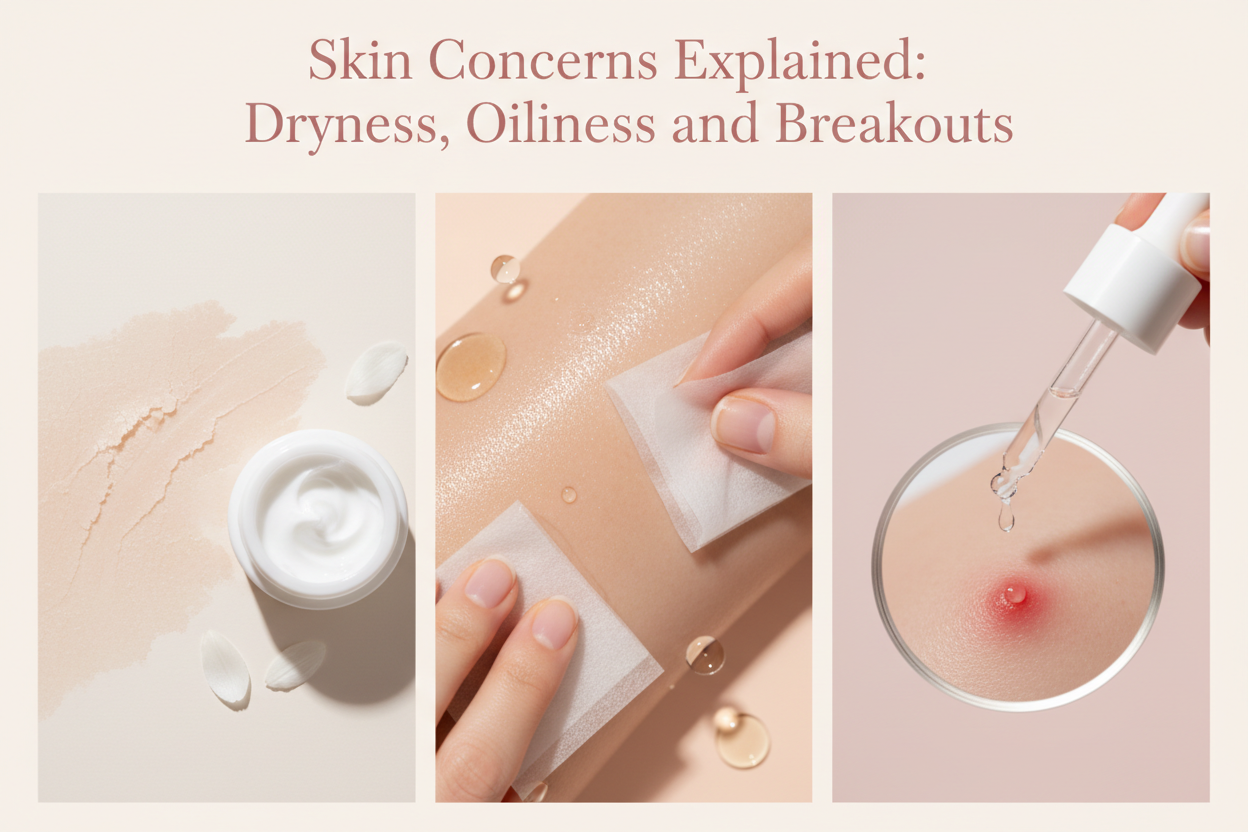
Skin Concerns Explained: Dryness, Oiliness and Breakouts
Most skin problems come down to three core concerns: dryness, excess oiliness, and breakouts. Many people deal with more than one of these at the same time, which makes it confusing to know what your skin actually needs.
This guide explains each concern clearly. What it is. Why it happens. What makes it better. What makes it worse. And which Gush Beauty products are best suited to managing each one.
Concern 1: Dry Skin
Dryness
What dry skin actually is
Dry skin is skin that does not produce enough natural oil, or sebum, to keep the skin barrier properly moisturized. This leaves the skin feeling tight, looking dull, and sometimes flaking or feeling rough to the touch. In more significant cases, dry skin can crack, especially around the nose and lips, and feel uncomfortable or itchy.
Dry skin is a skin type, meaning you are generally born with it. But dryness as a condition can also affect people who are not naturally dry, particularly due to weather, harsh products, age, over-exfoliation, or inadequate hydration.
Why it happens
The skin barrier, which is the outermost layer of your skin, is responsible for keeping moisture in and irritants out. When this barrier is compromised or naturally thin, moisture escapes faster than the skin can replenish it. Cold weather, low humidity, hot showers, alcohol-based products, and aggressive cleansers all speed up moisture loss.
Why does my skin feel dry even after moisturizing?
Dry skin after moisturizing usually means one of three things. You are applying moisturizer to completely dry skin rather than slightly damp skin, which reduces how much moisture gets sealed in. Your moisturizer is not rich enough for your skin's needs, particularly during winter or in air-conditioned environments. Or the moisturizer contains alcohol or fragrance that is counteracting its hydrating effects by disrupting the skin barrier. Try applying your moisturizer to slightly damp skin immediately after cleansing and let it fully absorb before any other products. If dryness persists, look for a formula with ceramides, hyaluronic acid, or glycerin as the main active ingredients.
What helps dry skin
The priority for dry skin is sealing in moisture before it escapes. Cleanse gently without foam or lather, moisturize on slightly damp skin immediately after, and layer a protective product, like a balm or oil, over the top if your skin feels particularly dry. Sunscreen is also critical for dry skin because UV damage further compromises the skin barrier and makes dryness worse over time.
The Clean Slate Cleansing Balm cleanses without the stripping effect of foaming cleansers, making it ideal for dry skin types. It leaves the skin comfortable and soft after rinsing rather than tight and dry. Follow with the Glow Getter Illuminating Moisturiser applied on slightly damp skin for the best absorption. Finish with the UV U Later SPF 50 Sunscreen Serum for daily UV protection. All three are from the Skin Care collection.
What makes dry skin worse
Hot water strips the skin of natural oils faster than warm water. Long showers and baths, especially in winter, are a significant driver of dry skin. Cleansers with sulfates or high alcohol content dry the skin further. Skipping moisturizer or applying it too long after cleansing means the surface moisture evaporates before anything seals it in.
For dry lips, which often go hand in hand with dry skin, apply the Butter Balm Hybrid Gloss Balm throughout the day. Lips have no oil glands so they cannot self-moisturize. Regular application of a nourishing balm is the only thing that keeps them from drying out and chapping.
Is dry skin the same as dehydrated skin?
No. Dry skin is a skin type defined by a lack of oil. Dehydrated skin is a temporary condition caused by a lack of water in the skin. You can have oily skin that is also dehydrated. Dehydrated skin looks dull, feels tight, and shows fine lines that disappear when you press the skin. It is usually caused by not drinking enough water, eating too much salt or alcohol, over-cleansing, or using harsh actives like retinol without enough moisturizer. Dehydrated skin responds well to hyaluronic acid and increased water intake. Dry skin responds better to oil-rich moisturizers and barrier-supporting ingredients like ceramides.
Concern 2: Oily Skin
Oiliness
What oily skin actually is
Oily skin produces more sebum than the skin needs. This excess oil coats the surface and creates a shiny appearance, particularly in the T-zone (forehead, nose, and chin). Oily skin tends to have larger-looking pores and is more prone to blackheads and certain types of breakouts than other skin types.
Oily skin is not inherently bad. Sebum is the skin's natural moisturizer and protective layer. People with oily skin often have a better-maintained skin barrier and tend to age more slowly than those with dry skin. The challenge is managing the excess without stripping the skin.
Why it happens
Genetics is the biggest factor. Some people naturally produce more sebum. Hormones also play a major role, which is why oiliness often increases during puberty, menstruation, or periods of stress. Diet can contribute: high-glycemic foods and dairy are associated with increased sebum production in some people. Humidity makes oily skin more noticeable, which is relevant across most of India year-round.
Why does my skin get oily by midday?
Skin that gets oily by midday is doing its normal job of producing sebum throughout the day. In people with naturally oily skin, this production is simply higher than average. Paradoxically, using products that are too drying or stripping can make this worse because the skin compensates for the stripped moisture by producing even more oil. Using a lightweight, non-comedogenic moisturizer and a balanced cleanser rather than harsh, mattifying products often reduces midday oiliness over time. For immediate midday management, blotting paper is more effective than adding more powder, which can build up and look cakey by the end of the day.
What helps oily skin
The key principle for oily skin is balance, not elimination. Trying to strip all oil from the skin through harsh products makes it produce more. A gentle cleanser, a lightweight non-comedogenic moisturizer, and daily sunscreen give the skin what it needs without triggering overproduction. Keeping pores clear through regular nose strips prevents sebum from building up into blackheads.
The Clean Slate Cleansing Balm works just as well for oily skin as for dry, because oil-based cleansers dissolve excess sebum effectively without over-stripping. Follow with a lightweight moisturizer and the UV U Later SPF 50 Sunscreen Serum, which has a serum texture that does not add heaviness or shine. For pore management, the Charcoal Nose Strips draw out sebum buildup from the T-zone once or twice a week. All from the Skin Care collection.
Makeup for oily skin
Oily skin benefits from lightweight, serum-formula makeup products that blend into the skin rather than sitting on top of it. Heavy foundations and powder-heavy products tend to slide on oily skin and look cakey by midday.
The Squishy Serum-Infused Liquid Blush is a strong choice for oily skin because its serum base merges with the skin rather than sitting on the surface where it can slip. The Play Lip and Cheek Tint is a lightweight tint format that also holds well on oily skin. For eyes, the Eye Like Options 2-in-1 Eyeliner and Kajal gives long-wearing definition. All are from their respective collections in the Skincare-Infused Makeup range.
Should oily skin skip moisturizer?
No. Skipping moisturizer on oily skin is one of the most common mistakes in skin care. When oily skin is left without hydration, the skin often produces even more sebum to compensate. A lightweight, non-comedogenic moisturizer gives the skin the signal that it has enough moisture, which can actually reduce oil production over time. Look for gel or fluid formulas rather than heavy creams for oily skin, and always apply to slightly damp skin for the best absorption without adding greasiness.
Concern 3: Breakouts
Breakouts
What breakouts actually are
A breakout happens when a pore becomes clogged with a combination of excess sebum, dead skin cells, and bacteria. Different types of breakouts look and behave differently. Whiteheads are closed pores filled with sebum. Blackheads are open pores where the sebum has oxidized and turned dark. Papules are red, inflamed bumps. Pustules are pimples with a white or yellow head. Cysts are deep, painful nodules under the skin.
Each type needs a slightly different approach. Surface whiteheads and papules respond well to hydrocolloid patches. Blackheads respond to pore-clearing treatments. Deep cystic acne usually requires a dermatologist's input.
Why it happens
Breakouts are triggered by many different factors. Hormonal fluctuations are one of the most common, particularly around the menstrual cycle, during puberty, or under stress. Certain foods can trigger breakouts in some people. Not removing makeup or sunscreen properly before bed is a reliable cause of repeated breakouts. Using comedogenic products or ones that do not agree with your skin type adds to the problem. And touching the face repeatedly during the day transfers bacteria to pores constantly.
Why do I keep getting breakouts even with a good skincare routine?
Persistent breakouts despite a good routine usually point to one of a few causes. Hormonal fluctuations that a topical routine cannot address. A product in the routine that is comedogenic or irritating your skin. Incomplete makeup or sunscreen removal at night. Dietary triggers that vary by individual. Or a pillow cover that needs washing more frequently. Try eliminating products one at a time to rule out a product reaction. If breakouts are consistent and severe, a dermatologist can help identify hormonal or dietary causes that topical care alone cannot fix.
What helps breakouts
The most important habits for breakout-prone skin are thorough nightly cleansing, using non-comedogenic products, treating pimples without touching or popping, and keeping pores clear between breakouts. Prevention is far easier than treatment. A skin barrier that is well-maintained and properly cleansed breaks out far less than one that is stripped, over-treated, or not properly cleaned at night.
Nightly removal of all makeup and sunscreen with the Clean Slate Cleansing Balm is the single biggest habit for reducing breakout frequency. For active pimples, the Dart It Hydrocolloid Pimple Patches provide hands-off overnight treatment that visibly reduces pimple size and redness by morning. For smaller, more surface-level spots, the Dart It Mini Tea Tree Pimple Patches are a more precise fit. Keep the Dart It Set of 5 stocked for ongoing use. Clear the nose area regularly with the Charcoal Nose Strips to prevent blackhead buildup from becoming inflamed breakouts.
What makes breakouts worse
Popping or squeezing a pimple forces bacteria into surrounding pores and causes post-inflammatory hyperpigmentation, the dark marks that last long after the pimple is gone. Over-treating the skin with harsh actives strips the barrier and triggers more oil production. Using heavy, comedogenic makeup over active breakouts traps debris in pores. And going to sleep with makeup on is one of the most reliable ways to ensure ongoing breakouts.
Post-breakout dark marks are often more frustrating than the breakout itself. Daily SPF is the most effective way to prevent them from deepening. UV exposure makes hyperpigmentation significantly darker and harder to fade. Wearing the UV U Later SPF 50 Sunscreen Serum every morning is the non-negotiable step for anyone dealing with post-acne marks.
How do I get rid of pimple marks fast?
Post-acne marks, also called post-inflammatory hyperpigmentation, fade with time and consistent care. Daily sunscreen is the most important step because UV exposure causes these marks to darken significantly and slows fading. Niacinamide applied consistently is the most evidence-backed ingredient for fading hyperpigmentation without irritation. Vitamin C is another option but can be irritating at higher concentrations. Avoiding picking at the original pimple prevents the mark from forming in the first place. With consistent sunscreen and a niacinamide product, most post-acne marks fade visibly within six to twelve weeks.
When You Have More Than One Concern
Most people do not fit neatly into one category. Combination skin, which is oily in the T-zone and dry on the cheeks, is the most common skin type. And breakout-prone skin often comes alongside either oiliness or sensitivity, not just on its own.
The good news is that the core routine works for all of these combinations because it is built around balance rather than extremes. Gentle cleansing, non-comedogenic hydration, daily sunscreen, and targeted spot treatment when needed is the correct framework regardless of whether your concern is primarily dryness, oiliness, or breakouts.
For Dry and Breakout-Prone Skin: Use the Clean Slate Cleansing Balm nightly. Apply the Glow Getter Illuminating Moisturiser on damp skin. Use the UV U Later SPF 50 Sunscreen Serum every morning. Apply Dart It Pimple Patches overnight on active spots. Use the Lavender Nose Strips weekly for gentler pore clearing.
For Oily and Breakout-Prone Skin: Use the Clean Slate Cleansing Balm every night followed by a second gentle cleanser if needed. Moisturize with a lightweight gel or fluid formula. Apply the UV U Later SPF 50 Sunscreen Serum daily. Use the Charcoal Nose Strips once or twice a week. Apply Dart It Mini Tea Tree Patches on spots overnight.
For Combination Skin: Use the Clean Slate Cleansing Balm nightly. Apply a lightweight moisturizer all over and a slightly richer product on dry cheek areas if needed. The UV U Later SPF 50 Sunscreen Serum works well for combination skin because the serum texture does not add heaviness to the oilier areas. Use the Charcoal Nose Strips on the T-zone weekly and spot-treat with Dart It Patches as needed. Add the Snatched Reusable Sheet Mask once a week for an all-over hydration boost.
Final Thoughts
Understanding your skin concern is half the battle. Once you know whether the root issue is moisture loss, excess oil, or clogged pores, the right product choices become much clearer. The three concerns in this guide are all manageable at home with consistent, gentle habits and the right targeted products.
Explore the full Skin Care collection at Gush Beauty to build the routine that fits your specific concerns. For product combinations that work well together, the Bundles and Sets are a practical and cost-effective way to start. And if you have questions about specific skin concerns, a dermatologist visit is always the most reliable next step.

From Office to Party: Press-On Nail Styles for...
Oct 19, 2026

Press-On Nails for Small Nail Beds: How to...
Oct 16, 2026

Press-On Nails for Weddings: How to Choose a...
Oct 12, 2026

Almond vs Round vs Coffin Nails: How to...
Oct 09, 2026

How to Choose the Right Press-On Nail Size...
Oct 05, 2026

Answers to the Most Confusing Beginner Beauty Questions
Sep 28, 2026

The Best Gush Beauty Products for a Minimal...
Sep 25, 2026

Beauty Trends That Look Great On Camera and...
Sep 21, 2026

Beauty Hacks That Make Your Makeup Last from...
Sep 18, 2026

Cruelty-Free Beauty vs Vegan Beauty: What Is the...
Sep 14, 2026