Gift Sets
 Fragrances
 Whip Lush
 BYOB Sale

 Eye Like Options
 Glow Getter
 Dart Its
 Stacked In Your Favour
 Bundles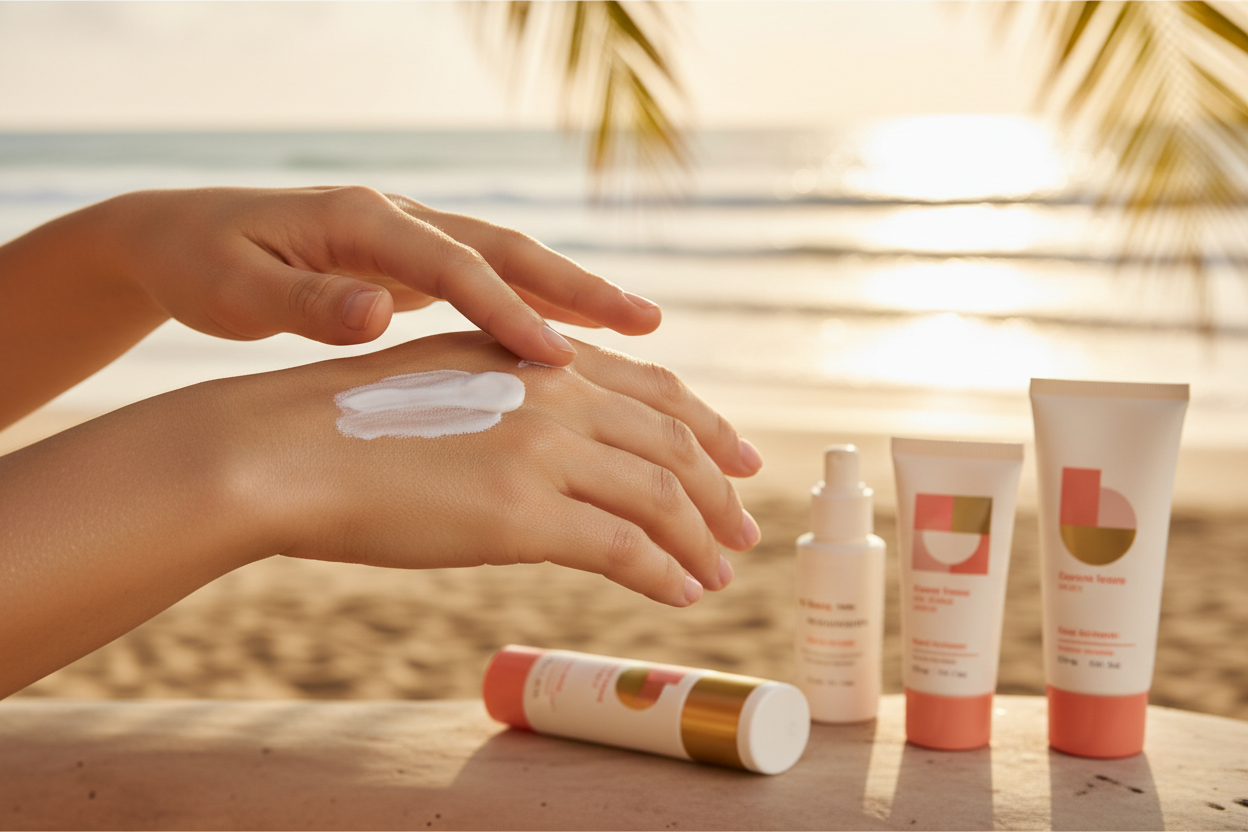
Sunscreen & Sun Protection: Why It's Non-Negotiable
Most people know sunscreen exists. Most people do not use it every day.
It gets skipped because the texture feels heavy. Or it leaves a white cast. Or it seems unnecessary on a cloudy day or an indoor workday. Some people assume the SPF in their foundation is enough. Others think darker skin tones do not need it.
None of these reasons hold up when you understand what UV exposure actually does to your skin every single day.
Sunscreen is not a summer product. It is not optional. It is the one skincare step that protects everything else you are doing. Gush Beauty makes it easier to wear daily with formulas that sit comfortably on Indian skin, absorb fast, and leave no cast. This guide explains everything you need to know.
What UV Rays Do to Your Skin
The sun sends out different types of rays. Two of them affect your skin every day.
UVB rays cause sunburn. They are strongest between 10am and 4pm. They affect the surface of the skin and are the reason skin turns red and peels after too much sun.
UVA rays go deeper. They reach the layer of skin where collagen and elastin live. UVA rays break down collagen over time. This is what causes fine lines, sagging, and dull skin. UVA rays are present all day. They pass through clouds. They pass through glass. You receive UVA exposure sitting near a window at work even on a rainy day.
For Indian skin tones, UV exposure is one of the biggest causes of post inflammatory hyperpigmentation. These are the dark marks that stay behind after a pimple heals. Melanin rich skin responds to UV triggered inflammation by producing more pigment. Daily sunscreen is one of the most effective ways to stop this from happening and getting worse.
Do darker skin tones need sunscreen?
Yes. This is one of the most common and most damaging myths in skincare. Melanin does provide some natural UV filtering but it is nowhere near enough for daily exposure levels. The way UV damage shows up is different. On lighter skin it shows as sunburn and redness. On medium to deeper Indian skin tones it shows as hyperpigmentation, dark spots, and uneven tone. These are harder to reverse once they appear. Consistent daily SPF is more important for Indian skin, not less.
Do UVA rays really come through windows?
Yes. Glass blocks most UVB rays but lets UVA rays through. If you sit near a window at home or at work, your skin is receiving UVA exposure every day. This is one reason people who never spend time in direct sun still develop pigmentation and visible signs of ageing over time.
Why You Cannot Only Use It in Summer
UV damage builds up over time. It does not reset between seasons.
UV index levels in Indian cities like Mumbai, Delhi, Bengaluru, Chennai, and Hyderabad are high for most of the year. Even in monsoon months when the sky is grey and the sun is hidden, UVA radiation is still active and reaching your skin. The cloud blocks the light you can see. It does not block the rays doing the damage.
Every day of unprotected exposure adds to the total. You may not see the effects now. In your twenties your skin repairs itself well enough to compensate. But by your thirties and forties the cumulative damage becomes visible as pigmentation, texture changes, and early ageing. People who have used SPF consistently from a young age show genuinely different skin over time compared to those who did not.
Daily sunscreen use is one of the most effective anti ageing steps in skincare. It costs significantly less than the serums and treatments people use later to try to reverse damage that could have been prevented.
Is sunscreen necessary on cloudy days?
Yes. Clouds block visible sunlight but not UV radiation. UVA rays in particular pass through cloud cover with minimal reduction. Wearing sunscreen on cloudy days is just as important as wearing it on sunny ones. Weather is not a reliable guide to UV exposure.
Is sunscreen necessary if I stay indoors all day?
For most indoor days one good morning application is sufficient. However, if you sit near windows, step outside for your commute or lunch, or spend any time in indirect sun, you are still receiving UV exposure. The habit of applying sunscreen every morning regardless of your plans is the safest and simplest approach. You do not have to assess the weather or your schedule every day. You just apply it.
Understanding SPF Numbers
SPF stands for Sun Protection Factor. It measures how well a sunscreen blocks UVB rays specifically.
SPF 15 blocks about 93 percent of UVB rays. SPF 30 blocks about 97 percent. SPF 50 blocks about 98 percent. The difference between SPF 30 and SPF 50 is about one percent, but for people managing hyperpigmentation or spending time outdoors that margin matters.
Dermatologists recommend SPF 30 as the minimum for daily indoor use. SPF 50 is the better choice for outdoor activity, high UV days, or anyone dealing with pigmentation concerns on Indian skin.
SPF only tells you about UVB protection. For UVA protection, look for the words broad spectrum on the label. Broad spectrum means the sunscreen protects against both UVA and UVB. This is non-negotiable. A sunscreen without broad spectrum protection is only doing half the job.
Many sunscreens also carry a PA rating. This is more common on Asian formulations. PA+ through PA++++ shows UVA protection level. PA+++ or PA++++ is what you want for daily use on Indian skin.
The UV U Later SPF 50 Sunscreen Serum from Gush Beauty is SPF 50 PA+++ broad spectrum. It covers both UVA and UVB at a level suited to Indian skin and climate conditions.
What is the difference between chemical and mineral sunscreen?
Chemical sunscreens absorb UV rays and convert them to heat. They tend to be lightweight, invisible on skin, and easy to layer under makeup. Most people find them comfortable for daily use.
Mineral sunscreens use zinc oxide or titanium dioxide to sit on top of the skin and reflect UV rays away. They are gentler for sensitive and reactive skin. They have historically left a white cast, though newer tinted formulas have reduced this significantly.
The UV U Later SPF 50 Sunscreen Serum uses a chemical filter system. It absorbs quickly, leaves no cast, and works on all Indian skin tones without changing the appearance of the skin.
How Much Sunscreen You Actually Need
Most people apply far too little sunscreen. This is one of the main reasons people think sunscreen is not working for them.
Studies show people apply between 25 and 50 percent of the amount needed for the listed SPF to be accurate. The recommended amount for the face and neck is about a quarter teaspoon or 1.5ml. That is more than most people use.
A simple way to check: use the two finger rule. Squeeze sunscreen along the full length of your index and middle fingers. That is roughly the right amount for your face and neck.
If you are using a powder SPF or a cushion SPF as your only sun protection, that is not enough. These formats do not deliver sufficient product to the skin to provide the full SPF on the label. They work well for reapplication over makeup during the day but should not replace a proper base application in the morning.
The Sunscreen Stick from Gush Beauty is designed for exactly this purpose. It is compact, easy to carry, and applies cleanly over makeup without disturbing your base. It is the practical solution for midday reapplication without needing to redo your whole face.
How do I apply enough sunscreen without it looking heavy?
The key is applying sunscreen in two thin layers rather than one thick layer. Apply the first layer, let it absorb for about 30 seconds, then apply a second light layer. This gives you the full recommended coverage without the heavy, greasy feeling that comes from applying everything at once. The UV U Later SPF 50 Sunscreen Serum absorbs fast enough that this takes less than two minutes total.
When and How to Reapply
Sunscreen breaks down over time. UV exposure itself degrades the formula. So does sweat, sebum, touching your face, and time passing.
The general rule is to reapply every two hours when you are outdoors. Reapply immediately after swimming or heavy sweating.
For indoor days with minimal direct sun exposure, one thorough morning application is usually enough. If you step outside at any point during the day, a reapplication with the Sunscreen Stick takes ten seconds and keeps your protection topped up without disturbing your makeup.
How do I reapply sunscreen over makeup?
This is one of the most practical daily questions about SPF. The Sunscreen Stick is the easiest solution. It applies directly over makeup without smearing or lifting your base. Glide it over sun exposed areas, press gently with clean fingertips to blend, and you are done. No need to remove and reapply makeup. Keep it in your bag and treat midday reapplication as the same habit as checking your phone.
Where Sunscreen Fits in Your Routine
Sunscreen goes on last in your morning skincare routine. Always.
The order is cleanser, then toner if you use one, then serum, then moisturiser, then sunscreen. After sunscreen comes makeup if you wear it.
Sunscreen needs to sit on the outermost layer of the skin to form an effective protective barrier. Applying other products over it or mixing it into your moisturiser dilutes the formula and reduces how well it works.
Do not mix SPF into your foundation. Do not rely on SPF in foundation alone. Apply a dedicated sunscreen as the final skincare step every morning and then apply your makeup over it.
The UV U Later SPF 50 Sunscreen Serum absorbs within about a minute. It does not pill under makeup. It does not shift your base. It is formulated to sit comfortably between your moisturiser and your makeup every single morning without friction.
One useful combination to know: vitamin C serum and sunscreen work together, not against each other. Vitamin C neutralises free radicals that UV exposure generates. SPF blocks the UV rays themselves. Using both gives more complete protection than either product delivers alone. Apply vitamin C as part of your serum step, let it absorb, then apply sunscreen over the top.
Does the SPF in my foundation count as sun protection?
It contributes but it is not enough on its own. To get the full SPF listed on a foundation you would need to apply far more product than most people wear. A dedicated sunscreen underneath your makeup gives you reliable protection regardless of how much or little base you apply. On minimal makeup days the UV U Later SPF 50 Sunscreen Serum can be worn alone as a sheer protective layer with no other base needed.
Common Mistakes That Reduce Your SPF Protection
Applying too little is the most common mistake. Use the full recommended amount every time.
Skipping reapplication outdoors leaves skin unprotected after the first two hours. The Sunscreen Stick makes this easy to fix.
Stopping at the jawline means the neck, ears, and backs of hands get daily UV exposure with no protection. These areas show visible ageing and pigmentation over time. Extend your sunscreen application past the jaw every morning.
Using expired sunscreen is more common than people realise. Most sunscreens have a PAO symbol on the packaging, a small open jar icon with a number that shows how many months after opening the product is usable. An expired sunscreen may look and feel the same but delivers significantly less protection.
Skipping sunscreen on overcast or cold days leaves skin exposed to UVA radiation that weather conditions do not reduce.
Frequently Asked Questions
What SPF should I use every day?
SPF 30 is the minimum for a standard indoor day. SPF 50 is recommended for outdoor activity, high UV days, or anyone managing pigmentation or uneven skin tone. The UV U Later SPF 50 Sunscreen Serum offers SPF 50 PA+++ broad spectrum protection and is formulated to be worn comfortably every day.
Does sunscreen prevent tanning completely?
No sunscreen blocks 100 percent of UV rays so some tanning is still possible. Consistent use of SPF 50 significantly reduces tanning and prevents the kind of UV damage that causes permanent pigmentation. The goal is not zero sun exposure but controlled, protected exposure every day.
Can sunscreen cause breakouts?
Some formulas can, particularly heavy or occlusive ones on oily or acne prone skin. The solution is finding the right formula, not skipping SPF. The UV U Later SPF 50 Sunscreen Serum is a serum texture that does not clog pores and works well on oily and combination skin without triggering congestion.
How do I get rid of the white cast from sunscreen?
Switch to a chemical formula. Chemical sunscreens absorb into the skin and leave no visible residue. The UV U Later SPF 50 Sunscreen Serum absorbs completely within about a minute and leaves no cast on any Indian skin tone. If you have been avoiding sunscreen because of white cast from a previous product, this formula removes that issue entirely.
Is one sunscreen enough for both face and body?
Technically yes but face specific sunscreens are formulated to be lighter, non-comedogenic, and less likely to cause congestion. Body sunscreens are often thicker and more emollient, which can clog pores on the face. It is worth having a separate formula for the face. Use the UV U Later SPF 50 Sunscreen Serum on your face and neck daily and a body sunscreen for exposed arms and legs when needed.
Can I skip moisturiser and just use sunscreen?
On some days, yes. The UV U Later SPF 50 Sunscreen Serum has a serum texture that layers comfortably directly on cleansed skin. For dry skin, applying the Glow Getter Illuminating Moisturiser underneath gives a more comfortable base. For oily skin on a low maintenance day, the serum alone works well.
What is the best sunscreen for Indian skin?
The best sunscreen for Indian skin is one with SPF 50 broad spectrum protection, no white cast, a lightweight texture that works under makeup, and a formula that does not trigger breakouts or oiliness. The UV U Later SPF 50 Sunscreen Serum meets all of these. It is built specifically for the Indian climate and the range of skin tones common across India.
Final Thoughts
Sunscreen is the one step that protects every other part of your routine. Your serums, your treatments, your glow. Without SPF, UV exposure undoes progress every single day.
Apply it every morning. Use enough. Reapply when you need to. Find a formula that makes the habit easy.
Explore the full Skin Play collection at Gush Beauty for the UV U Later SPF 50 Sunscreen Serum and the Sunscreen Stick. For value sets and product combinations, browse the Bundles and Sets.

Answers to the Most Confusing Beginner Beauty Questions
Sep 28, 2026

The Best Gush Beauty Products for a Minimal...
Sep 25, 2026

Beauty Trends That Look Great On Camera and...
Sep 21, 2026

Beauty Hacks That Make Your Makeup Last from...
Sep 18, 2026

Cruelty-Free Beauty vs Vegan Beauty: What Is the...
Sep 14, 2026

How to Choose the Perfect Nail Shape for...
Sep 11, 2026

Lip Makeup Tips: How to Choose the Right...
Sep 07, 2026

Why Sunscreen Is the Most Important Step in...
Sep 04, 2026

How to Shop for Makeup Without Feeling Overwhelmed
Aug 28, 2026

Multi-Tasking Beauty Products That Simplify Your Routine
Aug 24, 2026